

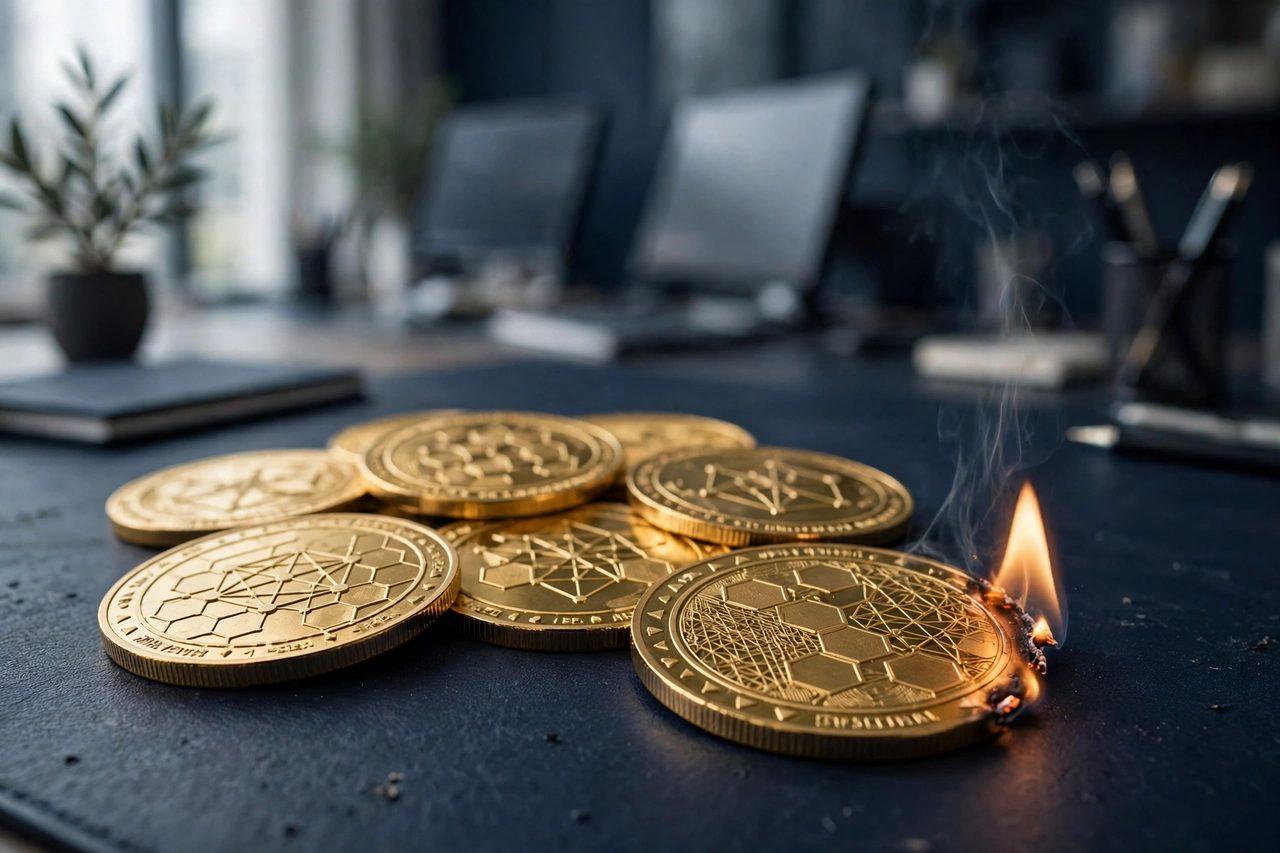

Token burning sounds dramatic, but the idea is simple: a project permanently removes some of its own tokens from circulation, so those tokens can never be spent, traded or used again. If you follow crypto news on the Zimbuck News page, you will regularly see headlines about a burn event — and the price reaction that sometimes follows it.
Understanding what a burn does — and cannot do — helps you read those headlines calmly. A burn changes supply. It does not create demand, fix a weak product or guarantee a price rise.

What token burning actually means
Burning means sending tokens to a wallet address nobody controls and for which no private key exists. Those tokens stay visible on the blockchain, but no one can ever move them again.
That is why a genuine burn reduces total supply. If you have read our guide to what tokenomics is and how token supply and demand work, a burn is one of the clearest supply tools in that rulebook.
How a token burn works, step by step
Most burns follow the same pattern, whether run by a team, an exchange or a protocol:
- Announcement or schedule: the project states how many tokens will be burned and when, or the rule is written into the protocol.
- Transfer to a burn address: tokens are sent to an unspendable address, sometimes called an eater address.
- On-chain proof: the transaction is recorded publicly, so anyone can check it on a blockchain explorer.
- Supply update: reported total or circulating supply is then reduced to reflect the burn.
Some tokens also have a burn function built into their smart contract, which destroys a stated amount directly with the same permanent result.
Why do projects burn tokens?
Burns are used to introduce deflationary pressure by shrinking supply, to link supply to real network use when part of a transaction fee is burned, and to keep a public commitment made at launch, such as a scheduled programme of periodic burns.
Two patterns illustrate the range. Ethereum's London upgrade in August 2021 introduced a mechanism that burns the base fee from each transaction, so supply falls when network use is high. Separately, some exchanges have carried out regular, scheduled burns of their own token. Binance Academy's explainer on tokenomics covers how burn schedules fit into wider supply and demand design.
Does burning a token raise its price?
Not automatically. If demand stayed exactly the same and supply fell, price could face upward pressure — but demand rarely stays the same. Traders may buy before an expected burn and sell afterwards, the burn may already be priced in, or the amount may be tiny compared with trading volume and new tokens still being issued.
So compare three things: the burn size versus circulating supply, new issuance over the same period, and whether anyone actually needs the token. Discussion in the Zimbuck Market News group often returns to that second point — a headline burn means little if inflation adds back more than was removed.
How to verify a burn yourself
Never rely only on a social media announcement. Find the burn transaction on a public blockchain explorer, confirm the destination is a known burn address, check the amount, and see whether supply figures were updated afterwards. If there is no transaction you can inspect, treat the claim with caution.
Frequently Asked Questions
Can burned tokens ever be recovered?
No. Once tokens are sent to an address with no private key, or destroyed through a contract burn function, they cannot be recovered or spent again.
What is the difference between a burn and locking tokens?
Locked tokens still exist and can return when the lock ends. Burned tokens are gone permanently, so total supply is lower for good.
Are all burns good for holders?
No. A burn helps only if it is real, verifiable and meaningful compared with new issuance and demand. A small, heavily promoted burn can be mostly marketing.
How often do burns happen?
It depends on the design. Some projects burn on a fixed schedule, some burn a share of fees with every transaction, and some burn only occasionally. The schedule should be in the project's documentation.
Token burning is a supply tool, not a promise. Check the proof, compare the burn with issuance, and ask where demand comes from — then join traders discussing crypto research on Zimbuck, the finance social platform. This article is general information only, not financial advice.






