

Why Small Bitcoin Withdrawals Cost More Later: How the Blockchain UTXO Model Really Works

Two wallets can show exactly the same Bitcoin balance and still pay wildly different fees for the same payment. A holder who withdrew 20 small purchases to a personal wallet can face a far higher fee when spending them than someone holding the same amount from a single withdrawal — because Bitcoin charges for the transaction data needed to spend each separate output, not a percentage of the value being sent.
It is one of the least understood mechanics on the Zimbuck News page: the balance on your wallet's home screen is a summary, not a single pot of coins. Underneath it sits a collection of separate receipts, and how those receipts arrived decides what your next payment costs.
One balance, many separate receipts
Bitcoin does not work like a bank account. The blockchain records transaction outputs — each with an amount and a set of conditions that must be met before it can be spent. An output that has not been spent yet is called a UTXO, short for unspent transaction output. Your wallet simply finds every UTXO it controls and adds them up to display your balance.
When you pay someone, the wallet consumes one or more of those outputs in full and creates new ones: one for the recipient, and usually a change output returning the remainder to you. That change becomes yet another UTXO waiting for a future payment.
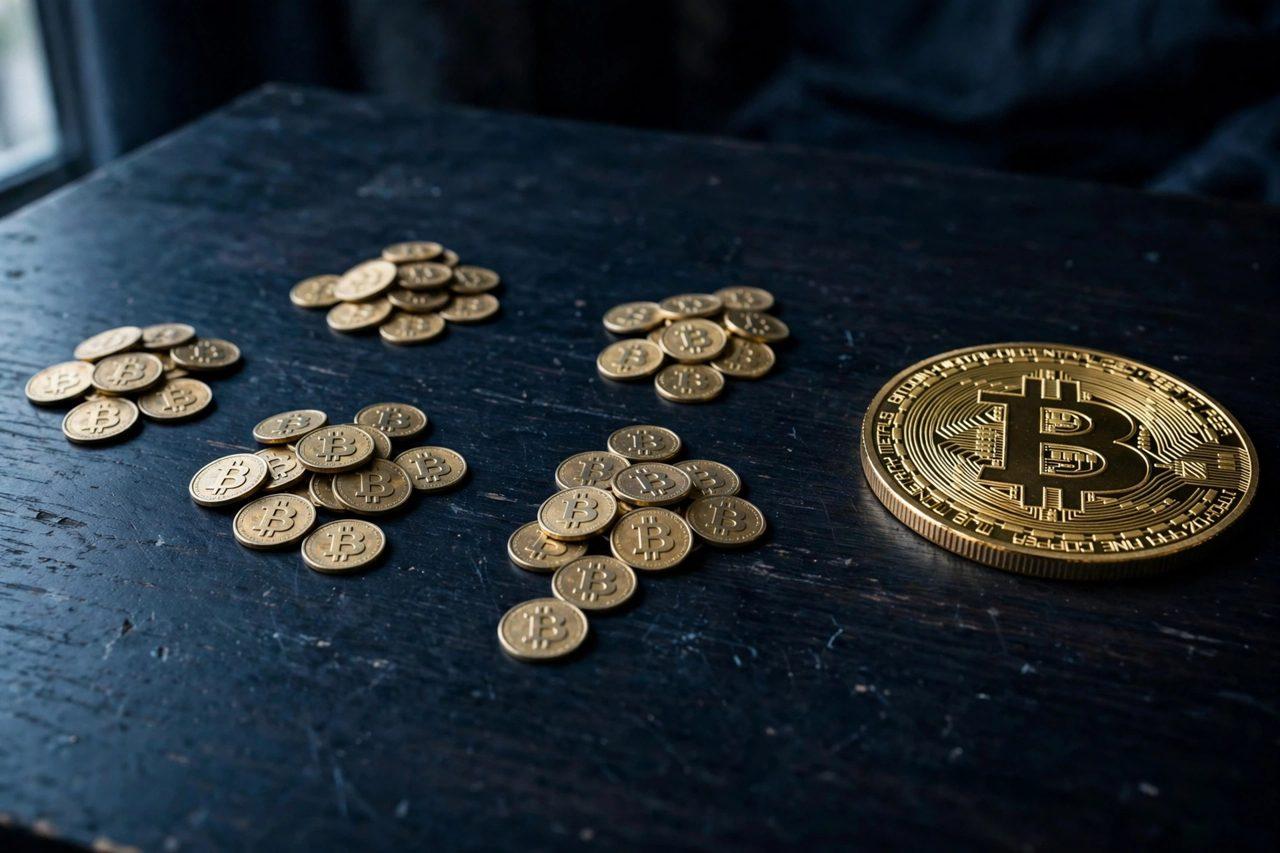
- Wallet 1: one single output of 200,000 satoshis (0.002 BTC).
- Wallet 2: twenty outputs of 10,000 satoshis each — the same 200,000 total.
- The catch: a payment needing most of the funds takes one input from Wallet 1, but many inputs from Wallet 2.
Receiving every withdrawal at the same address does not merge anything. An address can receive many transactions while each resulting output stays separately identifiable on the ledger — and even outputs that arrive inside one batched exchange transaction remain separate pieces the owner must later spend individually.
Fees follow data size, not payment value
A Bitcoin fee is calculated from the transaction's virtual size multiplied by a fee rate in satoshis per virtual byte. The dollar value of the payment plays no part. What matters is how much data each input needs:
- Legacy single-signature input: roughly 148 virtual bytes
- Native SegWit input: roughly 68 virtual bytes
- Simple Taproot key-path input: roughly 57.5 virtual bytes
Run the arithmetic on Wallet 2. Twenty native-SegWit inputs add about 1,360 virtual bytes before outputs and overhead. At a hypothetical 10 sats/vbyte, the inputs alone cost about 13,600 satoshis; at 100 sats/vbyte, about 136,000 satoshis — against a total balance of 200,000. A full worked example in the original analysis puts a 20-input payment at roughly 1,433 virtual bytes and 14,330 satoshis in fees, versus about 141 virtual bytes and 1,410 satoshis for the identical payment built from one input. These are illustrative rates, not today's fee market — but the ratio between the two wallets is the point, and it is why fee surprises spark such heated threads in the Zimbuck Market News group.
The exchange fee is only the first charge
There are actually two separate costs, and they are easy to confuse. The withdrawal fee an exchange charges when Bitcoin leaves the platform is the exchange's own policy charge. The network fee you pay later, when you spend what you received, is a different bill entirely — and that second bill is the one your UTXO count inflates.
Exchanges batch many customers' withdrawals into one transaction to save on their side, but batching does not merge the outputs each customer receives. Withdraw every week and the receipts still pile up as separate outputs in your wallet. A flat withdrawal charge also bites small transfers harder: a hypothetical 1,000-satoshi charge is 10% of a 10,000-satoshi withdrawal, but only 1% of a 100,000-satoshi one. The trade-off is real, though — combining withdrawals means leaving more Bitcoin under the exchange's control for longer, which is exactly the custody risk self-custody is meant to avoid. For a companion read on how on-chain fees surprise users, see our explainer on why a failed Solana trade still takes money from your wallet.

Consolidation: paying a small fee now to avoid a big one later
The standard fix is consolidation — a transaction that spends several of your own outputs and combines them into one larger output you also control. Done when fees are low and there is no rush, it buys future spending room cheaply. In the worked example, consolidating the 20 outputs at 2 sats/vbyte costs roughly 2,804 satoshis; the later payment then needs just one input. Combined cost across both transactions: about 4,214 satoshis, versus 14,330 for spending the 20 inputs directly at the higher rate.
Consolidation is not free money, and it is not always worth doing. It costs a fee itself, it publicly links outputs you may have kept separate for privacy, and if fees never rise — or a single existing output could have funded the payment anyway — you have paid for a transaction you did not need. A small output that is uneconomical to spend today is not lost or invalid, either; it simply waits for a cheaper fee environment. Treat it as a timing and custody decision, not an emergency.
FAQ
What is a UTXO in simple terms?
It is one unspent receipt of Bitcoin recorded on the blockchain. Your wallet balance is the sum of all the UTXOs your keys control.
Why did my small payment cost so much in fees?
Most likely your wallet had to combine many small inputs to fund it. Fees pay for transaction data, and every extra input adds data.
Does using a fresh address for each withdrawal cause this?
No. The input count comes from the number of outputs received, not the addresses. Address reuse is a separate privacy question.
Should I always consolidate?
No. Consolidation makes sense when fees are low, you expect to spend later when fees may be higher, and you accept the privacy trade-off of linking your outputs.
The full feature this article is based on is published by crypto.news, with input-size data drawn from Bitcoin Optech. If you hold Bitcoin in self-custody, open your wallet's coin-control view once — seeing your own UTXO list explains more than any fee estimate ever will. Join the discussion with other holders on Zimbuck, the finance social platform for traders and investors.
This article is market news and general information only, not financial advice.






