

Binance's $6.3 Billion Hack, Day Two: $3 Billion Frozen, $2.4 Billion Beyond Reach — and Why Bitcoin Cannot Be Frozen

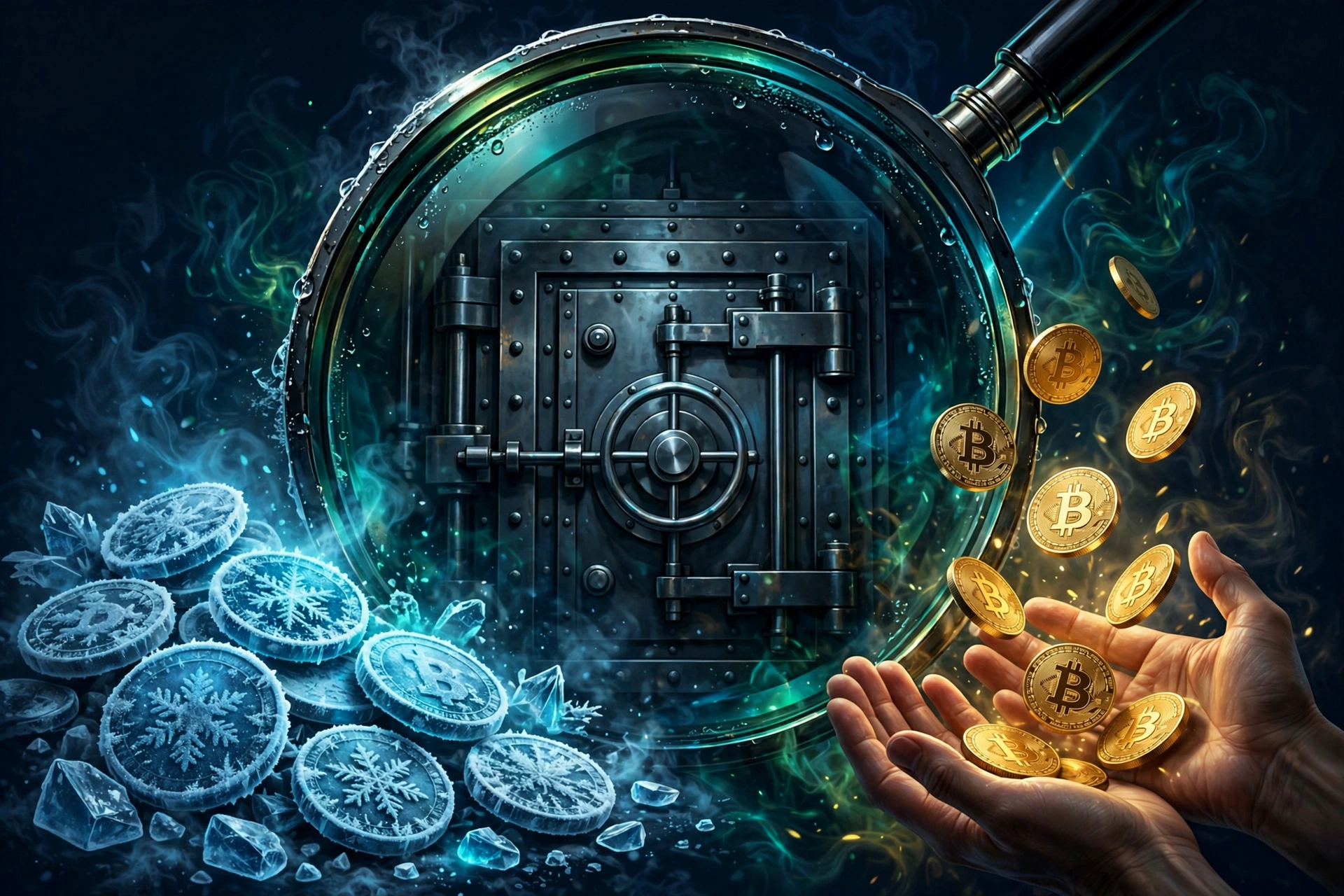
A day after the largest cryptocurrency theft on record, the Binance hack has split into two very different stories. One is about what the crypto industry could stop. The other is about what it could not. Roughly half of the estimated $6.3 billion taken from Binance has now been frozen by stablecoin issuers and other partners, according to the exchange's own verified tally of about $3 billion frozen. The rest — roughly $2.4 billion worth of bitcoin and ether, by TRM Labs' estimate — sits beyond anyone's reach, because no company issues bitcoin or ether and no company can freeze them. That split is the most important lesson of the hack so far. It is not just a story about one exchange's security failure. It is a live demonstration of how different crypto assets behave in a crisis — and why the same theft can be partly reversible and partly permanent at the same time.
What happened, in the confirmed facts: According to Binance and blockchain analytics firm TRM Labs, attackers compromised Binance's signing infrastructure — the system that authorises transactions — after gaining access through a compromised DevOps engineer's laptop and an internal service container. The bulk of the theft unfolded in about 20 minutes, beginning shortly after 2000 GMT on Thursday, October 29, draining wallets Binance uses to process transactions. Binance initially described a compromised laptop; TRM's analysis points to the signing infrastructure as the mechanism that let the attackers issue instructions emptying the affected wallets. Binance halted deposits and withdrawals, and co-founder Yi He said withdrawals would stay disabled until the environment is confirmed secure. Co-CEO Richard Teng said losses would be covered by the exchange's SAFU protection fund — a $1 billion bitcoin reserve designed for exactly this scenario — plus company resources. The exchange has also warned users to ignore unofficial links and messages asking for account details, as scammers tend to appear after major incidents.
What got frozen — and how: The frozen half of the story moved fast. Stablecoins such as Tether's USDT and Circle's USDC can be frozen remotely by their issuers, and that is what happened: Tether froze more than $1.5 billion by some tallies and Circle froze more than $800 million in coordination with law enforcement, with Ripple's RLUSD and World Liberty Financial's USD1 also freezing tokens tied to the breach. CryptoSlate put the combined freeze by Tether, Ripple and USD1 at $2.6 billion, and Binance's verified frozen total climbed from $2.54 billion to about $3 billion as more issuers and partners acted. This matters beyond Binance. Stablecoins now sit inside bank payment rails — Cross River put RLUSD into its core system on October 15, Visa settles in USDC, and Ripple's trust bank won final OCC approval on October 27. Every issuer's response this week gives banks a working record to compare against their own fraud and sanctions controls before those rails carry more volume. Freezing is not the same as returning the funds — frozen coins are limited in what the attacker can do with them, but recovery still depends on law enforcement and legal process — yet it is a containment tool that traditional bank wires do not offer in the same form.
What cannot be frozen: The other half of the story is starker. About $1.4 billion of bitcoin was split into 19 wallets that no one can freeze, according to CoinDesk's reporting, and TRM estimated about $2.4 billion worth of bitcoin and ether is beyond reach overall. Some of the funds were already posted as collateral to borrow ether. As Patrick Tan, general counsel of blockchain intelligence firm ChainArgos, put it: no company issues bitcoin or ether and no company can freeze either one. Those coins can only be stopped if the attacker sends them to an exchange or broker able and willing to freeze them, or if law enforcement obtains the private keys. That is the trade-off at the heart of crypto, stated in dollars rather than philosophy. Assets with an issuer behind them can be stopped after a theft. Assets without one cannot — which is precisely why many holders value them, and precisely why recovering them is so hard.
The market reaction: sharp, but contained so far: Bitcoin fell about 3% in 24 hours, dropping to an intraday low reported between about $76,300 and $76,500 before rebounding toward $77,800-$78,500, and it traded near $77,300 on Friday morning. Analysts at Cantor Fitzgerald, TD Cowen and Compass Point said the theft poses a limited threat to the wider crypto market and that the sell-off may present a buying opportunity; Compass Point is watching the $75,000 to $77,000 range, saying a break below it could jeopardise any rebound. Bitfinex had previously identified $77,000 to $77,765 as a crucial support region. The damage was still real for leveraged traders: the breach triggered about $1.53 billion in leveraged liquidations, with bitcoin accounting for roughly $499 million and ether about $358 million. The Crypto Fear & Greed Index fell to 30, in the Fear zone, from 51 (Neutral) the previous day. And $11.1 billion in Deribit bitcoin options were scheduled to expire on October 30 at 08:00 UTC, with a maximum-pain level estimated at $78,000 — a reminder that month-end positioning, not just the hack, shaped Friday's trading. One widely followed trader, Quinten Francois, called bitcoin holding $77,000 a sign of resilience, noting the asset has absorbed an unusual string of bad news this year yet still sits roughly 24% above where it started August, near $62,814, after climbing to about $78,549 in August and closing September near $83,554. Whether that resilience holds depends on the levels above: a swift recovery above $78,000 would suggest liquidation-driven selling has eased, while failure to hold it exposes $75,000-$76,000, and below that, $73,000.
What to watch next: Three things decide the next chapter. First, withdrawals: when Binance reopens them, and under what security assurances, will tell the market whether the signing infrastructure is genuinely fixed. Second, the frozen funds: whether law enforcement and issuers can convert freezes into returns, and how much of the $2.4 billion beyond reach ever surfaces at a compliant exchange. Third, regulation: experts told CNBC the hack shows the need for stronger cybersecurity regulation, and agencies are expected to push stricter zero-trust access controls, employee device security and multi-chain asset recovery standards. The Binance hack will be remembered as a record theft. Its longer legacy may be the freeze ledger: proof, in real time, of which crypto assets can be stopped after a crime — and which ones, by design, cannot.
Include internal links: Read more on Zimbuck: https://zimbuck.com/pages/zimbucknews and join the discussion at https://zimbuck.com/groups/zimbuckmarketnews . Related reading on the site: https://zimbuck.com/blogs/496/
FAQ: How much was taken in the Binance hack? An estimated $6.3 billion, according to Binance and TRM Labs — the largest cryptocurrency theft on record, with most transfers happening in about 20 minutes on October 29. How much has been frozen? About $3 billion verified by Binance, frozen by stablecoin issuers including Tether, Circle, Ripple and World Liberty Financial's USD1, plus other partners. Why can't the bitcoin be frozen? No company issues bitcoin or ether, so no issuer can remotely freeze those wallets; about $1.4 billion of bitcoin was split into 19 wallets, and TRM estimates about $2.4 billion of bitcoin and ether is beyond reach. Will users be made whole? Binance says losses will be covered by its $1 billion SAFU fund plus company resources, and co-founder Yi He said withdrawals stay disabled until the environment is confirmed secure. Is this the same story as the compromised-laptop report? The laptop was the entry point in Binance's initial account; TRM's analysis says the attackers then compromised signing infrastructure. This blog covers the Oct 30 freeze/recovery picture, not the cause alone. Did the hack break the wider crypto market? Not so far, analysts at Cantor Fitzgerald, TD Cowen and Compass Point said: bitcoin held near $77,000-$78,000 despite about $1.53 billion in leveraged liquidations.
Closing line: This article is market news and general information only, not financial advice.




