

Crypto Derivatives Explained: How Futures, Perpetuals and Options Work — and Why They Move Spot Prices

Spot trading is simple: you buy a coin, you own it, and its price rise or fall is your gain or loss. Derivatives are a step removed from that. A derivative is a contract whose value comes from something else — in crypto, usually the price of Bitcoin, Ethereum or another coin — and it lets traders bet on direction, hedge risk, or use leverage without ever owning the coin itself. Derivatives now dominate crypto trading volume, which means they also move spot prices, even for people who never touch them. This guide explains the three main types, the two mechanics that catch beginners out, and the risks that matter most. Dated futures: a bet with an expiry date.
A futures contract is an agreement to buy or sell an asset at a set price on a set future date. If you buy a Bitcoin future at $80,000 expiring in December, you profit if Bitcoin is above $80,000 at expiry and lose if it is below. Traditional futures converge to the spot price as expiry approaches, because on the settlement date the contract price must meet the real price. Futures existed long before crypto — farmers, airlines and oil producers have used them for decades to lock in prices — and crypto simply copied the design. The key idea for a beginner is that a future separates price exposure from ownership: you get the price move without holding the coin, paying fees, or arranging custody.
Perpetual futures: the contract that never expires.
Crypto's own invention is the perpetual future, or "perp". A perp works like a future but has no expiry date at all — a position stays open as long as you want it to. That raises an obvious problem: with no settlement date forcing convergence, what keeps the perp price near the spot price? The answer is the funding rate. Every few hours — every eight hours on most exchanges, hourly on some — traders on one side pay traders on the other. When the perp trades above spot, funding is positive and longs pay shorts; when it trades below spot, shorts pay longs. The payment goes between traders, not to the exchange. The logic is a nudge: holding the crowded side gets expensive, holding the unpopular side gets paid, so the gap to spot narrows. Perps are now the default contract on most crypto exchanges, and the funding rate itself has become a sentiment gauge — extremely positive funding means the market is heavily long, crowded, and vulnerable to a sharp unwind.
Options: paying for the right, not the obligation.
An option gives its buyer the right, but not the obligation, to buy (a call) or sell (a put) an asset at a set strike price before expiry, in exchange for an upfront premium. Buy a call and you profit if the price rises above the strike by more than the premium you paid; buy a put and you profit if it falls far enough. Unlike futures, where losses can exceed the margin posted, a bought option's maximum loss is the premium — that is why options are often described as defined-risk trades. The trade-off is time decay: an option loses value as expiry approaches, even if the price does not move, because the chance of a favourable move shrinks. Sellers of options collect the premium but take on the open-ended risk buyers avoid, which is why selling options without a hedge is a professional's game, not a beginner's shortcut.
Leverage, margin and liquidation: the part that wipes accounts out.
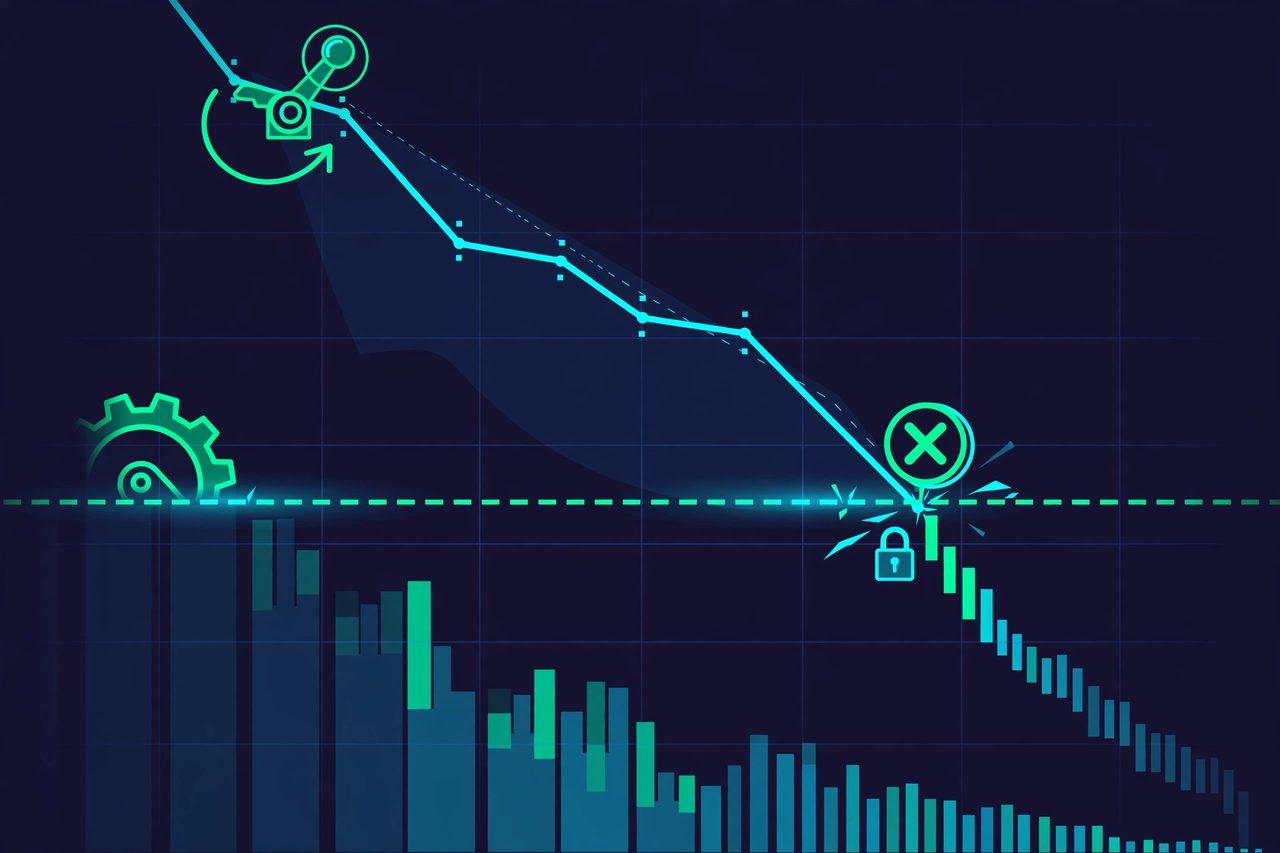
Leverage lets a trader control a position larger than the collateral posted. With $1,000 of margin at 10x, you control a $10,000 position — every 1% move in the asset is a 10% move in your equity, in both directions. The rough rule is simple: at leverage N, an adverse move of about 100/N percent wipes out the margin — about 10% at 10x, about 2% at 50x. In practice it happens sooner, because exchanges require a maintenance-margin buffer, and they liquidate against a mark price (a fair-value figure) rather than the last traded price. Liquidation is automatic: once your margin can no longer cover the loss, the exchange closes your position for you, and you lose the margin backing it. It is not a punishment; it is the mechanism that keeps the system solvent without anyone owing debt. But liquidation cascades are real: each forced sale pushes the price further, triggering the next liquidation, which is exactly what happened on October 10, 2025, when more than $19 billion of leveraged positions were forcibly closed within about a day after a tariff announcement, the overwhelming majority of them longs, according to Coinglass data cited by CoinGecko.
Why derivatives move spot prices.
Three channels link the two markets. First, liquidations in derivatives become forced spot selling or buying, amplifying moves. Second, funding rates and open interest — the total value of open derivative positions — signal positioning: extreme long positioning often precedes reversals, because there is nobody left to buy. Third, arbitrage ties the markets together: when a perp trades far above spot, traders buy spot and short the perp to collect funding, and vice versa, so spot demand itself is partly a function of derivative pricing. A spot-only investor who ignores derivatives is therefore ignoring the engine that often sets the next move.
A beginner's checklist before a first derivative trade.
First, know your liquidation price before you click, not after — every exchange shows it. Second, check the funding rate and which way it is running; holding the crowded side costs money every few hours. Third, size small: risk 1–2% of your account per trade, not half of it. Fourth, use low leverage or none at all while learning — the difference between 3x and 50x is the difference between a bad day and a wiped account. Fifth, never trade a derivative you cannot explain in one sentence: if you cannot say what expiry, strike, funding or liquidation means for your position, you are not ready for that contract yet.
FAQ
What is a crypto derivative? A contract whose value comes from the price of a coin, letting you bet on direction or hedge without owning the coin.
What is the difference between a future and a perpetual? A dated future expires and settles on a set date; a perpetual never expires and stays near spot through funding payments between longs and shorts.
Who receives the funding payment? The traders on the unpopular side — longs pay shorts when the perp is above spot, shorts pay longs when it is below. The exchange takes no cut of funding.
How does leverage wipe out a position? At 10x, roughly a 10% adverse move consumes your margin; at 50x, roughly 2%. The exchange then liquidates automatically, before your margin hits zero.
What is an option's maximum loss for a buyer? The premium paid upfront — unlike a leveraged future, a bought option cannot lose more than that premium, though time decay erodes its value.
Why did October 10, 2025 matter? More than $19 billion of leveraged positions were liquidated in about a day, mostly longs, showing how liquidation cascades amplify a market move.
Read more on Zimbuck: Binance's completed zero-knowledge proof of reserves is here, https://zimbuck.com/blogs/1028/Binance-Completes-Zero-Knowledge-Proof-of-Reserves-After-the-6 — plus the Zimbuck News page at https://zimbuck.com/pages/zimbucknews and discussion at https://zimbuck.com/groups/zimbuckmarketnews . A beginner's guide to crypto futures this explainer draws on is here: https://www.thestreet.com/crypto/newsroom/crypto-futures-trading-explained-a-beginners-guide . This is general information and education only, not financial advice. Join Zimbuck at https://zimbuck.com to follow more crypto learning guides.




