

How Memecoin Tokenomics Work: Supply, Burns, Taxes and Why Market Cap Can Mislead

A memecoin's price looks simple — a tiny number on a chart — but that number hides almost everything that matters. The real story is tokenomics: how many coins exist, who holds them, what happens on every trade, and whether the headline market cap means what it seems to. This guide explains memecoin tokenomics in plain language, using the three biggest memecoins as worked examples.
Start with the basic equation. Market cap = price x circulating supply. A coin priced at $0.00000478 is not "cheap" and a coin priced at $0.075 is not "expensive" — the price only makes sense next to supply. As of November 2, 2026, the three largest memecoins by market cap were Dogecoin at about $11.8 billion (price ~$0.07423), Shiba Inu at about $2.70 billion (price ~$0.00000457) and Pepe at about $2.04 billion (price ~$0.00000478). Dogecoin's price is roughly 15,000 times Pepe's — yet its market cap is only about six times larger, because Pepe has vastly more coins in circulation. Price alone tells you nothing; price times supply tells you the size of the bet.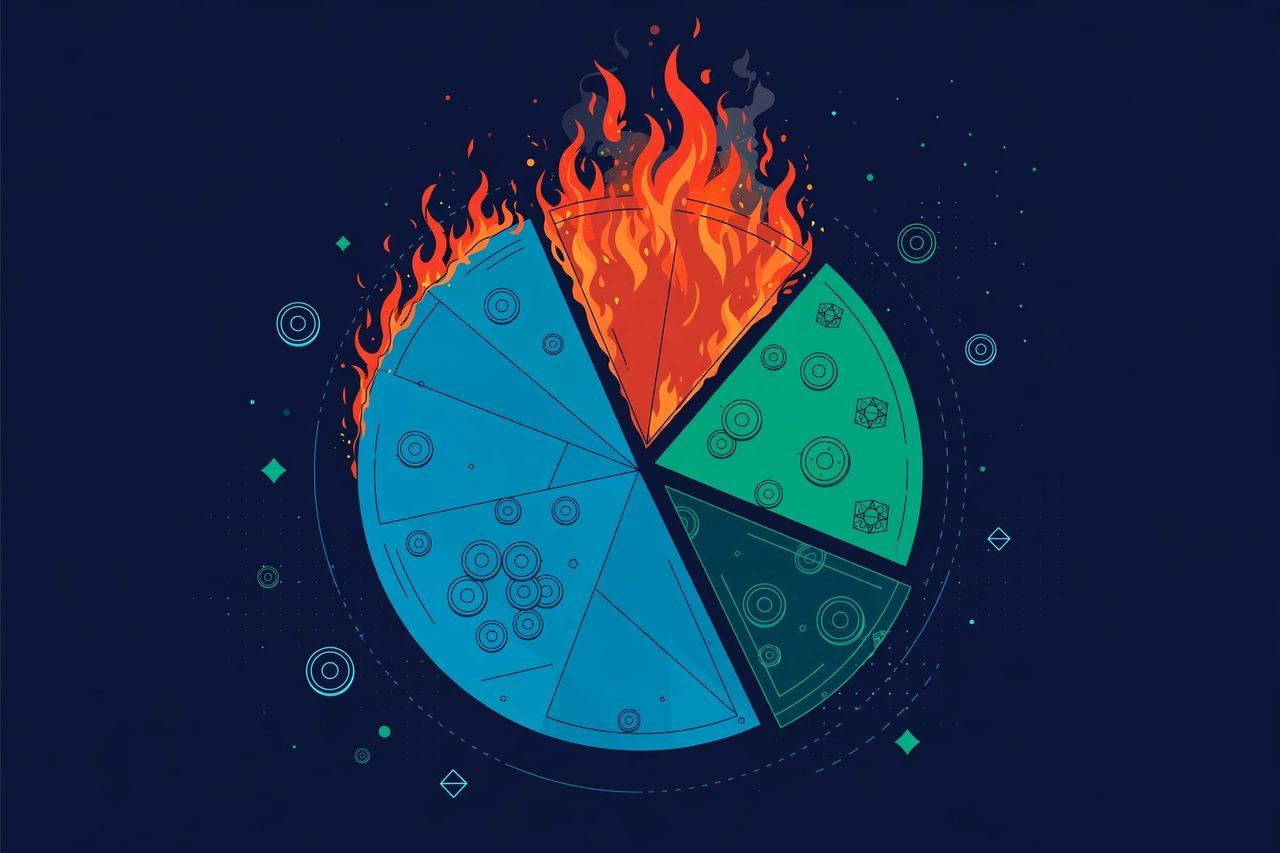
Supply: total, circulating, and what is actually free to trade
Three supply numbers matter, and projects sometimes blur them. Total supply is every coin that will ever exist under the current rules. Circulating supply is the coins currently in public hands, excluding locked, burned or team-reserved coins. Free float — the coins genuinely available to trade — is smaller still when large holders sit on their stacks and never sell.
For memecoins, the red flag is concentration: if a handful of wallets hold a huge share of supply, a single seller can move the price violently. That is exactly what happened when a wallet linked to the Binance hack dumped about $32 million of PEPE on October 30 — PEPE still rose that day because the sale was only about 1.5% of daily trading volume, but the episode showed how one holder's decision can become the whole market's problem. Before judging any memecoin, check holder distribution, not just the chart.
Burns, taxes and emissions: the levers that change supply
Memecoin supply is not fixed unless the design says so. Three levers move it: Burns — coins sent to a dead wallet, permanently removed from circulation. A burn reduces supply, which can support price if demand holds — but burns of tiny fractions of a huge supply are marketing, not economics. Always ask: what percentage of supply was actually burned? Transaction taxes — some memecoins take a cut of every buy or sell, for example a few percent redistributed to holders, sent to a burn wallet, or added to liquidity. Taxes discourage trading, distort the price you see versus the price you get, and can make exiting expensive exactly when you most want out. Emissions and unlocks — new coins minted as rewards or released from team and investor allocations increase supply over time. A memecoin with heavy ongoing emissions needs constant new buying just to hold its price — a treadmill many buyers do not notice until the chart goes flat despite steady "activity."
A healthy tokenomics design is boring in a good way: clear supply, small or zero trade taxes, no surprise unlocks, and burns that are verifiable on-chain rather than announced on social media.
Why market cap misleads — and what to check instead
Market cap is the standard size ranking, but for memecoins it has three traps. First, it values every coin at the last traded price, even coins that have never moved — a thin market can therefore produce a huge "valuation" on tiny real volume. Second, it ignores holder concentration: a $2 billion market cap spread across millions of holders behaves nothing like the same cap held by ten wallets. Third, it ignores liquidity: what matters for a real seller is not market cap but how much can be sold without crashing the price.
Better checks, in order: (1) daily trading volume relative to market cap — high turnover means exits are feasible; (2) liquidity depth in the main trading pool or order book; (3) holder distribution and the largest wallets' recent activity; (4) contract features — taxes, minting rights, and whether ownership is renounced or still controlled; (5) the community behind it, because for memecoins attention is the demand engine, as the site's earlier guide to memecoin communities explains. A coin that passes the tokenomics checks but has a dead community still has no buyers; a coin with a live community but broken tokenomics still has a supply problem waiting to happen.
A beginner's tokenomics checklist
1. Find the supply numbers — total, circulating, and the share held by the top 10 wallets.
2. Read the tax — what percentage is taken on buys and sells, and where does it go?
3. Check for unlocks — is new supply scheduled to hit the market, and when?
4. Verify burns — on-chain, in what size, as what percentage of supply?
5. Test the exit — how much volume trades daily, and how deep is liquidity?
6. Compare like with like — judge a memecoin against other memecoins on market cap and volume, never on unit price alone.
Memecoin tokenomics will not tell you whether a coin goes up. It will tell you whether the game is fair, whether you can get out, and whether the numbers on the screen mean what they appear to mean — and for the most volatile corner of crypto, that is the difference between a calculated risk and a blind one. Discuss tokenomics checks in the Zimbuck Market News group (https://zimbuck.com/groups/zimbuckmarketnews) and follow new learning guides on the Zimbuck News page (https://zimbuck.com/pages/zimbucknews). Join the conversation on Zimbuck (https://zimbuck.com) to keep learning.
FAQ
What is tokenomics? The economic design of a token: its supply, distribution, issuance, burns, taxes and incentives — the rules that decide how its value behaves.
Is a $0.000004 coin cheaper than a $0.07 coin? Not necessarily. Price times circulating supply (market cap) is the size comparison; a tiny price with a huge supply can be a bigger asset than a higher price with a small supply.
What is a token burn? Coins permanently removed from circulation by sending them to an unusable wallet. Burns only matter in proportion to total supply.
Why do some memecoins charge a tax on trades? To fund burns, holder rewards or liquidity — but taxes also raise the cost of entering and exiting, so check the rate before trading.
What is the single most important tokenomics check? Holder concentration plus liquidity: who owns the supply, and how much can actually be sold without moving the price.
Can tokenomics alone predict a memecoin's price? No — for memecoins, community attention drives demand, and tokenomics only describes the supply side of that equation.
This article is general educational information only, not financial advice.
References
Zimbuck News page: https://zimbuck.com/pages/zimbucknews
Zimbuck Market News group: https://zimbuck.com/groups/zimbuckmarketnews
Related blog: Dogecoin vs Shiba Inu vs Pepe: https://zimbuck.com/blogs/986/Dogecoin-vs-Shiba-Inu-vs-Pepe-What-Actually-Makes-the
Related blog: Why Memecoin Communities Move Prices: https://zimbuck.com/blogs/923/Why-Memecoin-Communities-Move-Prices-Attention-FOMO-and-the-Viral
Zimbuck: https://zimbuck.com
Quellen





