

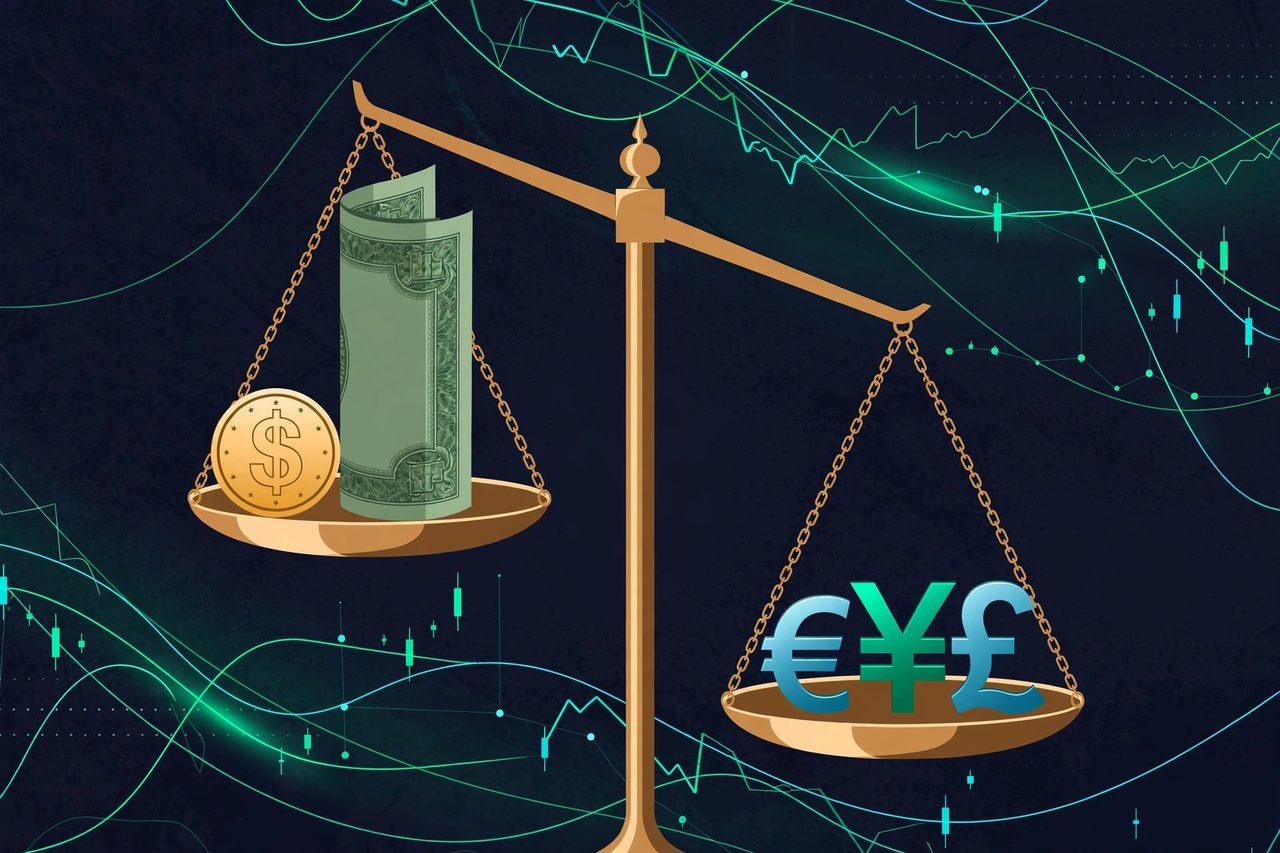
What Is the US Dollar Index (DXY)? How Dollar Strength Moves Stocks, Crypto and Gold

If you have ever watched the dollar rise and wondered why gold fell the same day, or why US exporters suddenly sounded gloomy, you have felt the US Dollar Index at work. Known universally as the DXY, it is the market's shorthand for the value of the US dollar against a basket of other major currencies. It is not a currency itself, and you cannot spend it — but it shapes the price of almost everything else, from oil and gold to stocks, bonds and crypto.
The DXY is calculated by ICE as a geometrically weighted average of the dollar against six
 currencies. It was created in 1973, after the Bretton Woods system of fixed exchange rates ended, with a base value of 100. A reading above 100 means the dollar is stronger, on average, than it was at that 1973 starting point; a reading below 100 means it is weaker. The index is quoted in real time during trading hours, and it has become the default gauge traders check before judging whether a move in another market is really about that market — or just about the dollar.
Inside the basket: six currencies, one euro-heavy mix
The DXY basket is not evenly spread. Its weights are: the euro at 57.6%, the Japanese yen at 13.6%, the British pound at 11.9%, the Canadian dollar at 9.1%, the Swedish krona at 4.2% and the Swiss franc at 3.6%. Because the euro dominates, the DXY is, in practice, mostly a dollar-versus-euro story, with the yen as the second voice. A sharp move in EUR/USD alone can move the whole index, even if other currencies are quiet. That is also why the DXY is a poor proxy for the dollar against emerging-market currencies or the Chinese yuan, which are not in the basket at all.
The geometric weighting matters too. Unlike a simple average, a geometric average means a 10% move in one currency does not simply add a fixed amount to the index; the effect depends on the starting level. It also prevents any single currency from dominating the maths in the way an arithmetic average might. For most readers, the practical point is simpler: watch the euro first, the yen second, and remember the basket is a 1973-vintage snapshot of trade partners, not a complete map of today's global economy.
What moves the dollar, and the Dollar Smile
Three drivers dominate. First, interest-rate differentials: when US rates rise relative to Europe or Japan, dollar assets pay more, attracting capital and lifting the DXY. When the Federal Reserve cuts while others hold, the opposite usually happens. Second, inflation: higher US inflation erodes the dollar's real value, but if it forces the Fed to stay hawkish, it can paradoxically support the dollar in the short run. Third, risk sentiment, captured by the Dollar Smile theory. The dollar tends to strengthen both when the US economy is booming and attracting investment, and when global panic sends investors fleeing to the safety of US Treasuries. It weakens in the middle — when the rest of the world is growing steadily and investors feel comfortable taking risk elsewhere.

Early 2026 illustrates the point. The DXY traded around 99 in early 2026, down roughly 10% from its January 2025 peak above 109. That decline reflected, among other things, shifting rate expectations and a rotation toward risk assets outside the US. It was not a collapse of the dollar, but a normalisation from a very strong level — a reminder that even a 10% index move, spread across major currencies, is a large shift in global finance.
How a strong dollar moves stocks, crypto and gold
A strong dollar usually pressures gold and other commodities, because they are priced in dollars: when the dollar rises, it takes fewer dollars to buy the same ounce or barrel for holders of other currencies, and demand often softens. It also squeezes US multinationals, whose overseas earnings translate back into fewer dollars, hurting reported profits even when local sales are healthy. For emerging markets, a strong dollar raises the burden of dollar-denominated debt, making repayment more expensive in local-currency terms and sometimes triggering capital outflows.
Crypto's relationship is real but imperfect. A rising DXY often coincides with tighter financial conditions and lower risk appetite, which can weigh on Bitcoin and altcoins. But crypto also moves on its own catalysts — ETF flows, regulation, halvings and network upgrades — so the correlation breaks down for weeks or months at a time. Treat DXY as context for crypto, not as a trading signal on its own: a falling DXY is a tailwind, not a guarantee, and a rising DXY is a headwind, not a death sentence.
Key takeaways
- DXY = geometrically weighted average of the dollar vs six currencies, calculated by ICE, created in 1973 with base 100.
- Weights: EUR 57.6%, JPY 13.6%, GBP 11.9%, CAD 9.1%, SEK 4.2%, CHF 3.6%.
- Early 2026: around 99, down about 10% from the January 2025 peak above 109.
- Drivers: rate differentials, inflation and the Dollar Smile — strength in both US booms and global panics.
- Effects: strong dollar pressures gold and commodities, multinationals' translated earnings, emerging-market dollar debt, and crypto risk appetite, with imperfect correlation.
Frequently asked questions
Is a high DXY good or bad? It depends on who you are. US importers and consumers benefit from cheaper imports; US exporters, commodity producers and dollar borrowers abroad usually suffer. There is no universally good level.
Can I invest in the DXY directly? You cannot buy the index itself, but you can trade dollar futures, currency ETFs and forex pairs that track it, each with different risks and costs.
Why is the euro so important to the DXY? Because its 57.6% weight dwarfs the others. EUR/USD is the world's most traded currency pair, and the eurozone is the US's largest comparable trading bloc.
Further reading
Read the Zimbuck News page, join the Zimbuck Market News group, and see the related GDP guide: What Is GDP? How Growth, Revisions and Per-Capita Figures Actually Work — https://zimbuck.com/blogs/1030/What-Is-GDP-How-Growth-Revisions-and-Per-Capita-Figures — plus an authoritative explainer at https://financer.com/invest/dxy-index/ . Keep following Zimbuck News at https://zimbuck.com/pages/zimbucknews and the Zimbuck Market News group at https://zimbuck.com/groups/zimbuckmarketnews , and join us at https://zimbuck.com .
This article is for education only and is not financial advice. Currency markets are volatile, and index levels do not predict future prices.




