


What Is Impermanent Loss? How Liquidity Providers Lose Money in DeFi — Even When Prices Rise

Providing liquidity to a decentralised exchange sounds like free money: deposit two tokens, earn a share of every trade's fee, and watch the yield roll in. Many first-time liquidity providers get a shock instead — they withdraw less value than they would have had by simply holding the same tokens in their wallet. That gap has a name: impermanent loss. It is the single most misunderstood cost in DeFi, and it can quietly eat every cent of fee income.
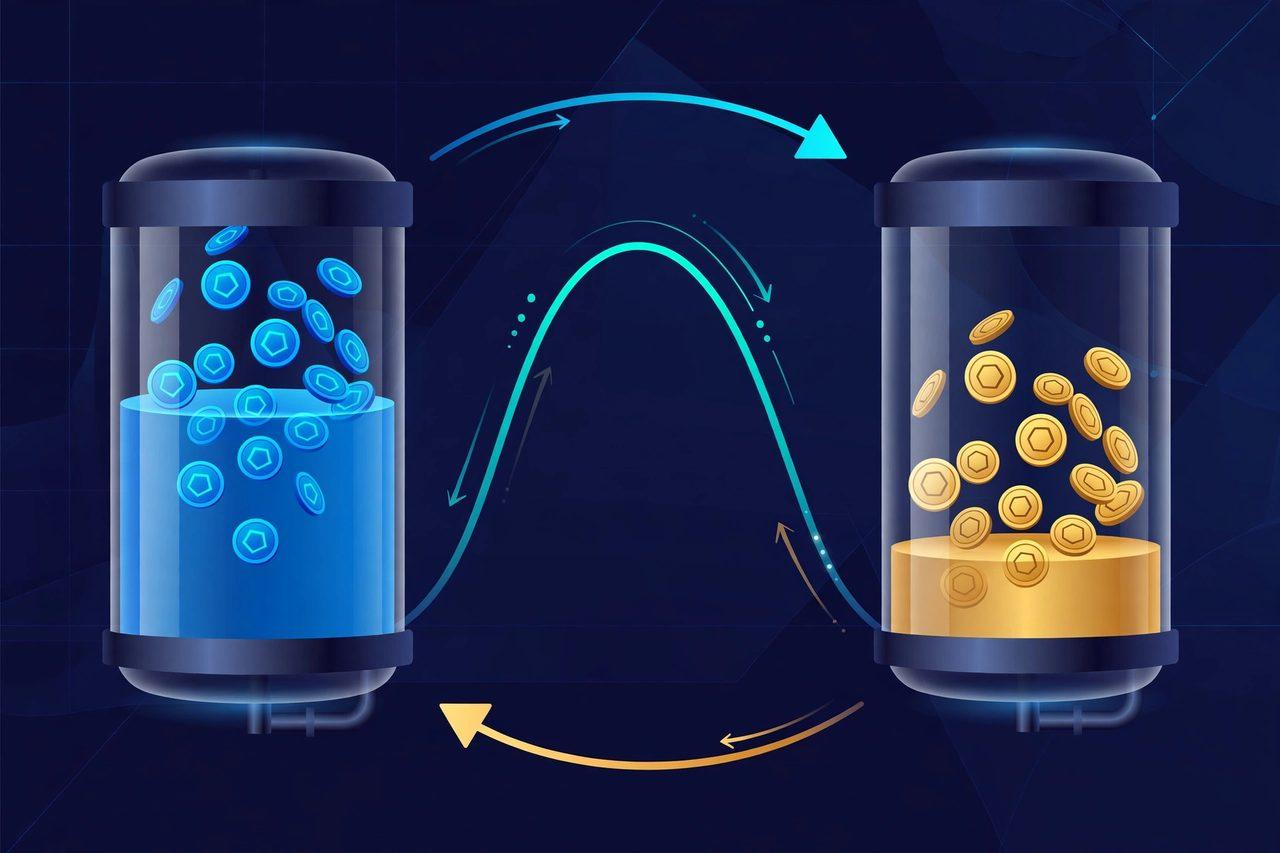
What impermanent loss actually is
Impermanent loss is the difference between the value of your tokens inside a liquidity pool and the value of the same tokens if you had just held them. It appears whenever the relative price of the two tokens in a pool changes from the ratio at the moment you deposited. It is called "impermanent" because it only becomes permanent when you withdraw: if the price ratio returns to where it started before you exit, the loss disappears.
The cause is the automated market maker itself. A pool like Uniswap v2 keeps the product of its two token balances constant — the x * y = k formula. When one token's price rises on the wider market, arbitrage traders buy the cheaper token from the pool until the pool's price matches the market. The pool ends up selling the token that gained and buying the one that fell — the exact opposite of what a holder wants. You leave the pool with more of the token that lost relative value and less of the one that gained.
The numbers: a real Uniswap example
Uniswap's own documentation walks through this case. A liquidity provider deposits 10,000 DAI and 100 WETH — $20,000 in total — when ETH trades at $100. The price then rises to $150 on exchanges like Coinbase. Arbitrageurs trade against the pool until it reflects the new price, and the pool rebalances to roughly 122,400 DAI and 817 ETH in total. The provider's 10% share is now worth about $24,500. Sounds like a profit — until you compare it with holding: the same 10,000 DAI plus 100 WETH at $150 would be worth $25,000. The $500 difference is impermanent loss. The position still gained in dollar terms, but it gained $500 less than doing nothing.
The maths is symmetric and it grows fast. In a 50/50 pool, the loss is 2 x sqrt(r) / (1 + r) - 1, where r is the change in the price ratio:
- Price doubles (2x) or halves (0.5x): 5.7% behind holding
- Price moves 4x in either direction: 20% behind holding
- Price moves 5x: about 25% behind holding
A more recent example makes it concrete: a $10,000 deposit split between ETH and USDC when ETH traded at $2,273.92 would be worth $14,142.14 if ETH doubled — against $15,000 for simply holding the same coins, or $857.86 behind, before fees. And the loss cuts both ways: if ETH halves, you are behind by the same 5.7%. Any move away from the deposit ratio costs you, up or down.
Can trading fees cover it?
Sometimes — but rarely as fast as people assume. Uniswap v2 pools charge traders 0.30% per swap, shared among liquidity providers. Fees accumulate only when people trade, so a quiet pool pays almost nothing while a volatile pair racks up impermanent loss quickly. In the $10,000 example above, that position would need roughly $667 million of pool trading volume to earn back its $857.86 in fees — about 22 weeks at that pool's busy-week pace, but years at a quiet-day pace. Fee income is real, but it is slow, uneven, and never guaranteed. Our guide to what TVL in DeFi counts explains how to judge whether a pool is busy enough to be worth it, and our liquid staking explainer covers a yield route that avoids impermanent loss entirely.
How to reduce impermanent loss
- Provide liquidity in stable pairs. Two stablecoins barely move against each other, so impermanent loss is close to zero — but so are the fees.
- Pick pairs you would hold anyway. If you believe in both tokens long-term, the "loss" is just a different mix of assets you already wanted.
- Use concentrated liquidity carefully. Uniswap v3 lets you focus your range, which earns more fees but amplifies impermanent loss if the price leaves your range.
- Check the fee-to-volatility balance. A pool needs heavy, steady volume to out-earn its impermanent loss. Low-volume pools on volatile pairs are the worst combination.
- Consider single-sided options. Liquid staking and lending earn yield without a two-token pool, so there is no impermanent loss at all.

FAQ
Is impermanent loss a real loss?
It is a real shortfall against holding, measured at withdrawal. While your tokens stay in the pool it is only on paper — if prices return to the deposit ratio, it vanishes. The moment you withdraw, it becomes permanent.
Can impermanent loss happen if prices go up?
Yes — and that surprises most people. If one token rises, the pool sells some of it for the other token, so you capture less of the rally than a holder would. A doubling costs 5.7% against holding; a 4x move costs 20%.
Do fees always offset impermanent loss?
No. Fees depend on trading volume, while impermanent loss depends on price movement. A volatile pair in a quiet pool can lose far more to impermanent loss than it ever earns in fees.
Which pools have the least impermanent loss?
Stablecoin pairs (USDC/USDT, for example) have almost none, because the two assets barely move against each other. The trade-off is much lower fee income.
Where can I read the official maths?
Uniswap's developer documentation explains the formula and the worked example used in this guide: Understanding Returns — Uniswap Developers.
Impermanent loss is not a bug — it is the price of being the market maker. Before you deposit into any pool, run the numbers: how far can the price move, how much would that cost you, and is the pool busy enough to pay you back? If you cannot answer all three, hold the tokens instead. For more DeFi explainers, follow the Zimbuck News page and join the Zimbuck Market News group — and join the conversation on Zimbuck, the finance social platform for traders and investors.
This article is market news and general information only, not financial advice.




