

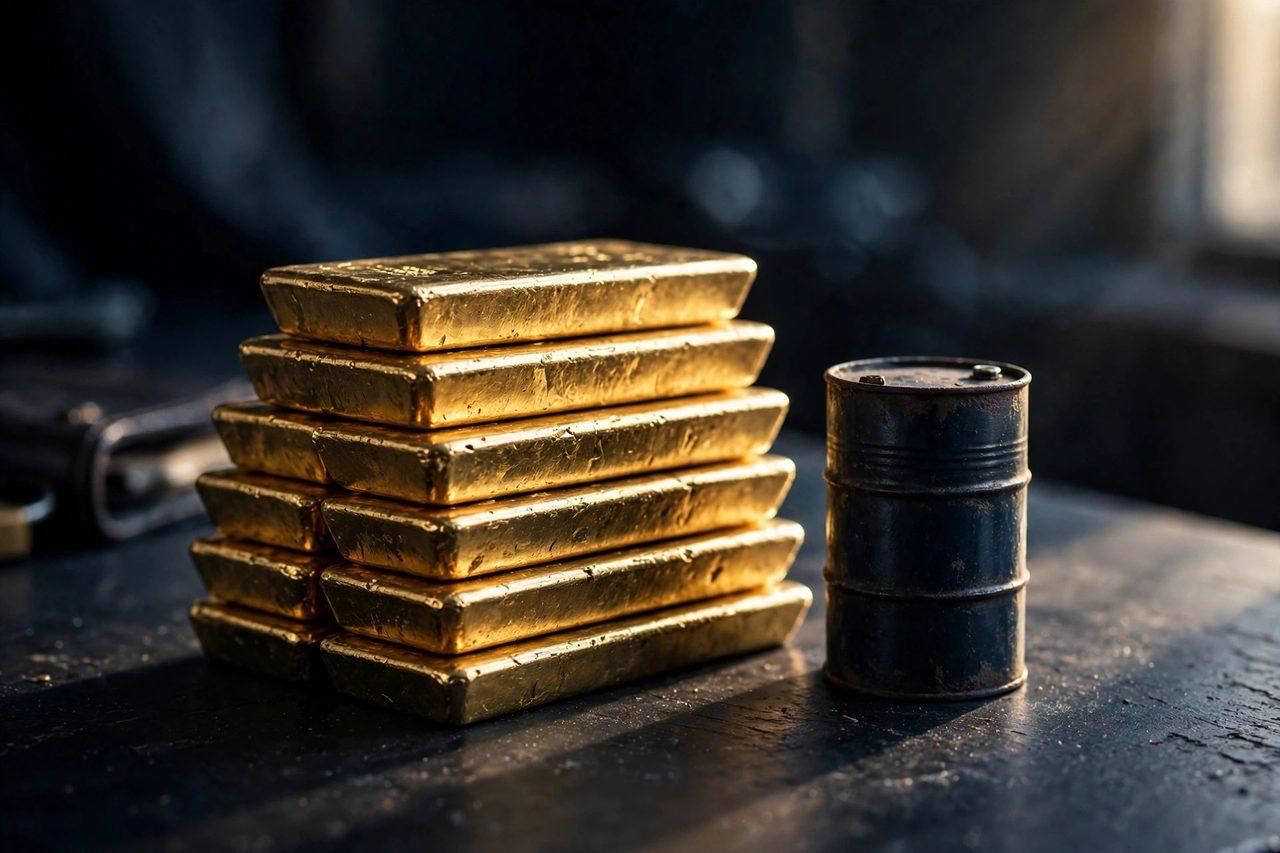
Gold Slips Below $4,100 as Oil Rebounds — Markets Hold Their Breath for the US Jobs Report

Gold gave back part of its recovery and oil pushed back toward $100 on Friday morning, November 6, 2026, in a sharp intraday reversal that left both markets waiting on the same thing: the US jobs report released at 13:30 GMT. Spot gold fell 1.1% to $4,044.09 an ounce by 05:01 UTC, slipping back below $4,100 barely a day after touching $4,146.63 — its highest since October 20. At the same moment, January Brent crude climbed 1.31% to $99.58 a barrel, extending a rebound that began with Thursday's near-4% surge.
This is Friday's reversal story, not a repeat of the week's wrap. The week as a whole still belongs to gold — but Friday morning belongs to oil, inflation worries, and a market that did not want to commit before the payrolls number landed.
Gold: A $100 Round Trip in Less Than a Day
Gold's Friday slide was fast. The metal traded at $4,100.27 at 19:05 UTC on Thursday and $4,044.09 at 05:01 UTC on Friday — a drop of more than $56 an ounce, or about 1.4%, overnight. December US gold futures fell to $4,053.30, and an earlier Reuters snapshot at 02:48 GMT had spot gold at $4,063.39, down 0.6%.
The trigger was oil. A rebound in crude revived inflation worries and reinforced expectations that US interest rates will stay higher for longer — exactly the combination that weighs on gold, which pays no yield and competes with bonds for investor money. A firmer dollar added to the pressure.
But the bigger picture has not changed. Gold is still up roughly 4% so far this week, its best week since late August, after a seven-session recovery that lifted it about 4.4% from the October sell-off. Thursday's intraday peak of $4,146.63 was the highest since October 20, and the $4,000 level remains the key psychological support that traders are watching — Goldman Sachs' analysts and independent strategists alike have flagged it as the line that matters.
Goldman Sachs Cuts Its Gold Target by $500
The other weight on gold this week came from the forecasters. Goldman Sachs on Thursday cut its end-2026 gold price forecast to $4,150 an ounce from $4,650 — a reduction of nearly 11% — and lowered its end-2027 projection to $4,800 from $5,400. The bank cited the Federal Reserve's more hawkish stance in recent months, even as it stressed that central-bank buying should keep providing a floor for prices. Goldman still expects central banks to keep buying gold in large quantities, at around 60 tonnes a month through 2027, on concerns about the safety of foreign-exchange reserves.
The cut is a downgrade, not a capitulation. The revised $4,150 target sits only about 2% above Friday morning's spot price — Goldman is saying the easy upside is limited for now, not that the bull market is over. Capital Economics has made a similar point, flagging limited room for further gains while the Fed stays hawkish and technology shares stay weak.
Oil: Two Days of Rebound, Still a Bad Week
Oil's move is the mirror image of gold's. January Brent futures rose 1.31% to $99.58 a barrel at 05:04 GMT on Friday, after briefly crossing $100, while US West Texas Intermediate gained 0.95% to $91.38. That follows Thursday's sharp rally, when Brent settled up 3.88% at $98.29 and WTI up 2.72% at $90.52.
The driver is maritime security in the Middle East. Renewed attacks on oil tankers raised fears of supply disruption through the Gulf, and analysts warned prices could stay vulnerable to sudden jumps until there is a credible path to safer, cheaper transit through the region. Brent and WTI both fell more than 8% on Wednesday to their lowest settlements in over two months, so the last two sessions are a bounce from a deep hole, not a new uptrend.
Step back and the week still looks grim for crude. Both benchmarks remain on course for weekly losses of around 12% — Brent about 12% and WTI about 12.1% — even after the rebound. JPMorgan estimated the global oil market ran a surplus of about 1.1 million barrels a day in September, widening to 1.4 million barrels a day in October, as high prices weakened demand and supply conditions improved. That surplus is the fundamental headwind the tanker headlines are fighting against.
For the forces behind these swings, our explainer on what drives oil prices — OPEC, supply, demand and geopolitics breaks down each driver in detail.
The Rest of the Metals Board
Gold was not the only metal moving on Friday morning. The wider precious-metals complex was mixed, with the Reuters 02:48 GMT snapshot showing:
- Silver: up 0.3% to $51.91 an ounce — holding near record territory even as gold slipped.
- Platinum: up 0.4% to $1,523.63 an ounce.
- Palladium: down 0.2% to $1,029.22 an ounce.
Silver's resilience stands out. While gold gave back its Thursday gains, silver held firm — a reminder that the two metals do not always move together, and that industrial demand gives silver a different set of drivers. (Note: later snapshots during the day showed slightly lower readings — spot gold $4,044.09 at 05:01 GMT versus $4,063.39 at 02:48 GMT — so treat each quote with its timestamp.)
Why Everything Waited for 13:30 GMT
Update: the report is out, and it was a big beat. Nonfarm payrolls rose 165,000 in October, far above the 65,000 consensus, the unemployment rate edged down to 4.1%, and average hourly earnings rose 0.4% on the month (3.1% year on year) — hotter than the 0.3% monthly and 2.9% yearly expected. The immediate read-through is straightforward: firmer December hike bets, a stronger dollar and more pressure on gold, the same higher-for-longer logic that pushed gold lower this morning.
All three markets spent the morning hostage to the same event: the October US jobs report. It has now landed — and it was a big beat (see the update above): 165,000 jobs against 65,000 expected, unemployment down to 4.1%, wages up 0.4% on the month.
The report matters for commodities through the interest-rate channel. A strong number would firm up bets on a December Fed rate hike — markets were pricing roughly 68–70% odds after Thursday's stock sell-off, down from about 83% before it — and a higher-for-longer Fed is bad for gold and supportive for the dollar. A weak number would do the opposite: cooler hike bets, a softer dollar, and likely relief for gold.
Oil's link is more indirect but just as real. Higher oil prices feed inflation expectations, which feed rate expectations, which feed back into gold. That loop is exactly what played out on Friday morning: oil up, inflation worries up, gold down.
The backdrop is a stock market in trouble. The Nasdaq fell 5.52% on Thursday into a formal correction, and Asian markets fell sharply overnight. In that environment, gold's traditional safe-haven role is competing with a simple fact: when rates are expected to stay high, holding non-yielding gold costs more.
What to Watch Next
- The jobs report is out — and it was hot. Payrolls +165,000 vs 65,000 expected, unemployment 4.1%, wages +0.4% on the month. The print has already re-priced December hike bets higher, and gold keeps reacting first.
- The $4,000 level in gold. A break below it on a strong jobs number would open a deeper correction; holding it would confirm the week's recovery is intact.
- Whether Brent holds $100. The round number is psychological; a sustained break above it would signal the tanker premium is growing, while a fade back below $98 would hand control back to the surplus story.
- Fed speakers later today. Fed Vice Chair Michelle Bowman is scheduled to speak after the payrolls data, and her tone will matter for the December 9 decision.
- The weekly closes. Gold is still set for its best week since late August; oil is still set for a ~12% weekly loss. How Friday ends decides whether those weekly stories survive the day.
This Friday reversal is distinct from the week's broader story — our earlier gold and oil week-wrap covered the week as a whole, while today's move is about one morning, one trigger, and one report that has now landed hot.
FAQ
Why did gold fall on Friday if it is up 4% this week? Gold fell 1.1% to $4,044.09 on Friday morning because rebounding oil revived inflation worries and higher-for-longer rate expectations, and a firmer dollar added pressure. The weekly gain of about 4% is still intact — Friday is a pullback inside a strong week, not a reversal of it.
Why is oil rising? Renewed attacks on oil tankers in the Middle East raised supply-disruption fears. Brent rose 3.88% on Thursday and another 1.31% early Friday to $99.58, with WTI at $91.38. Both are still down about 12% on the week.
What did Goldman Sachs change? Goldman cut its end-2026 gold forecast to $4,150 from $4,650 and its end-2027 forecast to $4,800 from $5,400, citing a more hawkish Fed. It still expects central banks to keep buying gold.
How does the jobs report affect gold and oil? A strong jobs report lifts December rate-hike odds, which usually pressures gold and supports the dollar. A weak report does the opposite. Oil is affected indirectly, through inflation expectations and the dollar.
What are the key levels to watch? Gold: $4,000 support, $4,125–$4,147 resistance. Brent: $100 psychological level, $98.29 Thursday settlement. Silver: holding near $51.91.
The Bottom Line
Friday morning delivered a clean reversal: gold below $4,100 at $4,044.09, oil pushing toward $100 at $99.58, and a $500 Goldman forecast cut hanging over the metals market — all of it unfolding hours before the jobs report rewrote the story by the afternoon. Whether today ends as a healthy pullback in gold's best week since August or the start of something deeper depends on how markets digest one number: 165,000 jobs, far above the 65,000 expected. Follow the reaction on the Zimbuck News page, discuss it in the Zimbuck Market News group, and keep the conversation going on Zimbuck.
This article is market news and general information only. It is not financial advice. Always do your own research before trading.




