

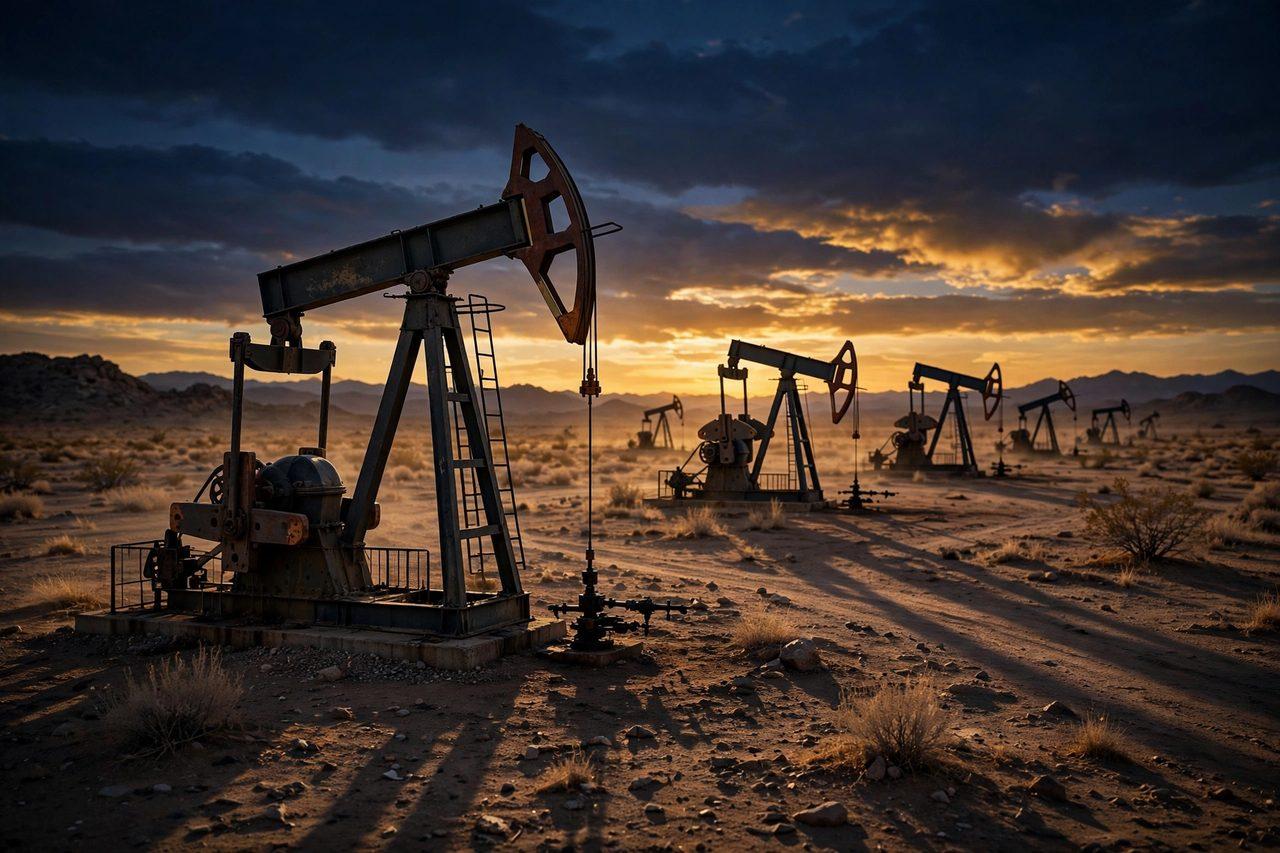
Oil's Wild Week: Brent Crashes 14% as Iran Talks and a Tanker Attack Collide

Oil just had one of its wildest weeks of the year. Brent crude fell below $100 a barrel and closed the week down nearly 14%, its sharpest weekly drop in years — then clawed back above $98 on Friday as a tanker attack and the prospect of new US strikes on Iran reminded traders that the Middle East can still move prices in an afternoon.
It was a week where every force in the oil market pulled in a different direction: a global surplus pushing prices down, war risk pushing them up, and a hot US jobs report pushing the dollar — and gold — around in between.
The week in numbers
Friday's official settlements tell the story of a market that fell hard, then steadied:
- Brent crude (January): $98.32 a barrel, up just 3 cents on Friday — but down nearly 14% for the week
- WTI crude (December): $90.83 a barrel, up 0.34% on Friday
- Natural gas: +1.73% to $2.998 per million Btu — the strongest energy contract of the day
- Gold (December futures): $4,074.90 an ounce, down 0.94% on Friday, but up about 4% for the week — its best week since late August
- Palladium: $1,017.10 an ounce, down 2.60% — the deepest fall of any commodity tracked on Friday
- Silver: about $51.51 an ounce, down on the day but heading for a weekly gain; platinum was the only metal to rise on Friday
Early on Friday, spot gold had slipped 1.1% to $4,044.09 an ounce, giving back part of Thursday's surge to $4,146.63 — its highest intraday level since October 20. The trigger was oil itself: crude's rebound revived inflation worries and reinforced expectations that US interest rates stay higher for longer. Goldman Sachs underlined the shift on Thursday, cutting its end-2026 gold price forecast to $4,150 an ounce from $4,650.
 Why oil fell: surplus, midterms and Iran
The weekly collapse had three drivers. First, supply: JPMorgan estimated the oil market was in surplus by about 1.1 million barrels a day in September and 1.4 million in October. When the market has more oil than it needs, prices drift down — and this week they fell off a cliff.
Second, politics: after the US midterm elections, in which President Trump's Republican Party suffered major losses, traders began pricing in a de-escalation of the Iran conflict. Hopes of a diplomatic path took the war premium out of the price, and Brent slid below $100.
Third, momentum: once Brent broke $100, selling fed on itself. The weekly drop of nearly 14% was the kind of move that forces funds to cut positions, which pushes prices lower still.
For the background on what moves oil prices in the first place, see our guide What Drives Oil Prices?.
Why oil bounced: a tanker, a threat and a deadline
Friday's rebound came from the other side of the same story. The United Kingdom Maritime Trade Operations organisation recorded an incident on November 5 involving a tanker reportedly struck by unidentified projectiles north of Qatar, with the extent of damage and the crew's condition unconfirmed in its initial notice.
Reuters reported that crude futures edged up late on Friday on renewed fears of further US strikes on Iran, as President Donald Trump said he would soon decide whether to pursue a peace agreement or destroy what remains of Iran. One market estimate put flows through the Strait of Hormuz below 60% of capacity — an analyst estimate, not independently verified shipping data, but enough to make traders nervous.
The result was a split day: Brent ended almost unchanged, WTI a touch higher, and natural gas led the energy board. Nine of the seventeen commodity contracts tracked settled up on Friday. The message is that the market no longer trusts either direction — the surplus says down, the geopolitics says up, and traders are caught in between.
Gold and silver: the haven that still gets sold
Gold's week is a reminder that even safe havens can fall on a given day. Bullion gained about 4% for the week — its best since late August — yet fell roughly 1% on Friday. The cause was the strong US jobs report: payrolls rose 165,000 in October against a 59,000 forecast, pushing the dollar and Treasury yields higher and changing the market's view of the next Federal Reserve decision.
Silver held up better, staying near $51.51 and heading for a weekly gain, while platinum was the only metal to rise on Friday. Palladium's 2.6% drop led the metals lower. The pattern is familiar: when rates stay higher for longer, gold's rally pauses — but the week's 4% gain shows the underlying bid for precious metals has not gone away.
Our Friday-morning coverage of gold slipping below $4,100 as oil rebounded is here: Gold Slips Below $4,100 as Oil Rebounds. For the longer view on how gold and oil move together, see our earlier gold and oil week-wrap.
 What to watch next
Three things decide where commodities go from here. First, Washington's next move on Iran — a peace deal would take more premium out of oil; strikes would put it straight back. Second, the Strait of Hormuz: any disruption to shipping there moves Brent within hours. Third, the Fed: the December 8–9 meeting and the December 4 jobs report will set the dollar, and the dollar sets gold.
For traders in Pakistan, India and Bangladesh, the practical read is this: oil below $100 eases fuel-price pressure, but the weekly 14% swing shows how fast that can reverse. Gold near $4,075 is still historically high — the metal is up roughly 4% in a week even after Friday's dip. Neither market is giving a clean signal right now, and that is itself the signal: size positions for volatility, not for direction.
FAQ
How much did oil fall this week? Brent crude fell nearly 14% for the week, dropping below $100 a barrel, before settling at $98.32 on Friday. WTI settled at $90.83.
Why did oil rebound on Friday? Renewed fears of US strikes on Iran, a tanker incident north of Qatar on November 5, and President Trump saying he would soon decide between a peace agreement and further action. War risk put a floor under prices.
Why did gold fall on Friday if it had a good week? Gold gained about 4% for the week — its best since late August — but fell about 1% on Friday after the hot US jobs report pushed the dollar and Treasury yields higher, reinforcing higher-for-longer rate expectations.
What is the Strait of Hormuz and why does it matter? It is the narrow waterway through which a large share of the world's seaborne oil passes. Any threat to shipping there raises the risk premium in crude prices almost immediately.
Where can I follow commodities? Follow the Zimbuck News page and join the discussion in the Zimbuck Market News group. Settlement data in this blog comes from the exchanges via Morningstar / Dow Jones.
This is market news and general information only, not financial advice. Join the conversation on Zimbuck — the finance social platform for traders and investors: https://zimbuck.com




