

Canada, Britain and America Are Writing Stablecoin Rules at the Same Time — and the Binance Freeze Just Showed Why

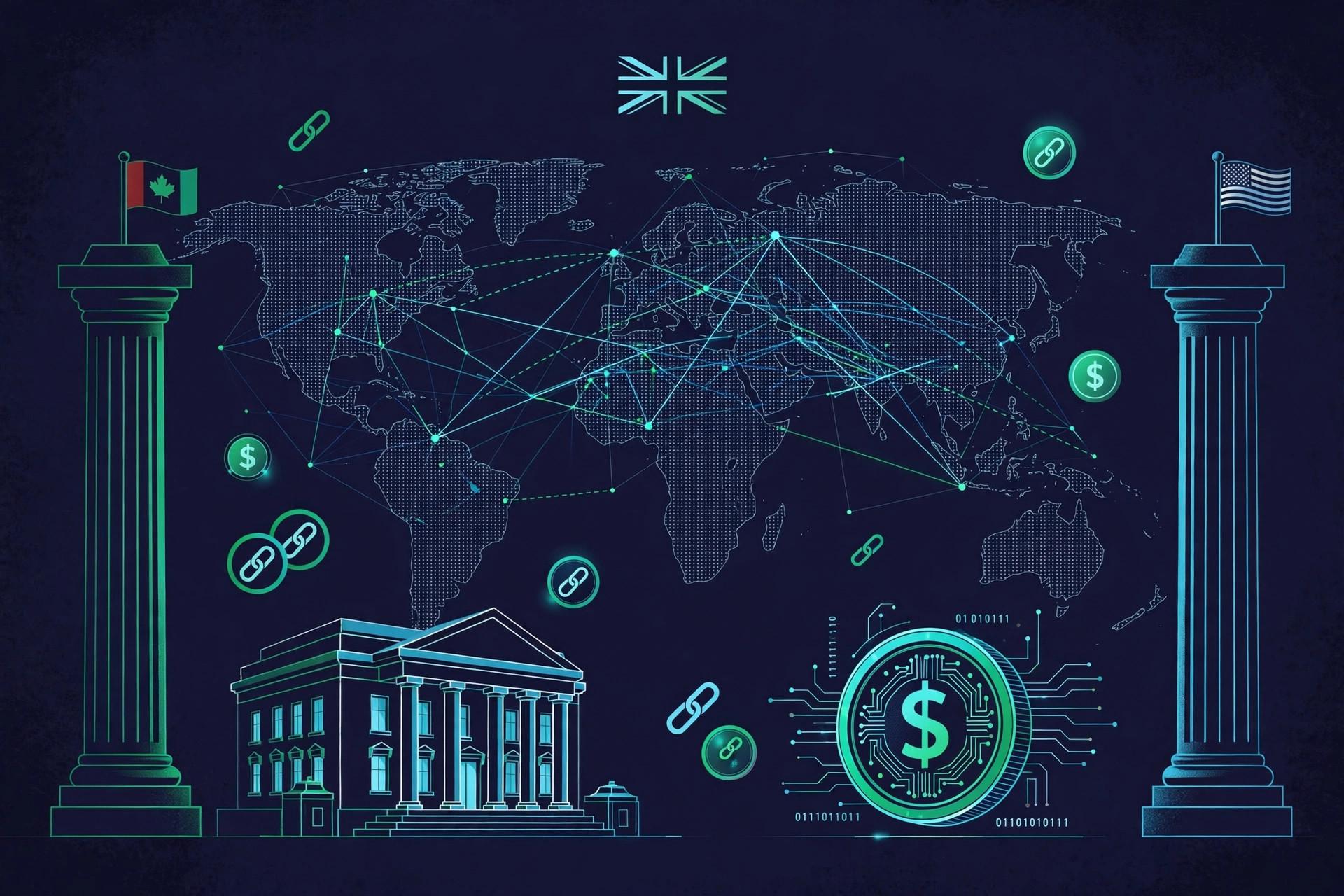
Three countries moved on stablecoin regulation in the same week, in the same direction: issuers must prove reserves, honour redemptions, and be able to freeze tokens when the law says so. Canada published proposed stablecoin regulations for public comment, Britain's FCA opened a dedicated stablecoin cohort inside its Regulatory Sandbox, and the US GENIUS Act regime takes effect January 18, 2027, including a Treasury proposal forcing American exchanges to audit foreign stablecoin issuers or stop offering their tokens. The Binance incident, in which Tether and Circle froze more than $2.3 billion combined in a single evening, is the live demonstration of why regulators care about the freeze ability above all.
Canada
Proposal published for public comment, covering domestic and foreign nonbank issuers, excluding prudentially regulated banks/credit unions. Reserve assets with qualified custodians incorporated in Canada, safeguards if an issuer becomes insolvent, disclosure plus monthly reports to the Bank of Canada, redemption at face value initiated within three business days, no interest or yield simply for holding, no misleading government-backed or insured claims. Retail Payment Activities Act oversight extended to payment providers handling stablecoin transactions, including certain exchanges, wallets and payment processors. Supervision primarily with the Bank of Canada. Canada explicitly follows the US GENIUS Act and Europe's MiCA.
Britain
FCA launched a special cohort within its Regulatory Sandbox for firms issuing tokens pegged to GBP/USD. David Geale, FCA executive director for payments and digital finance, said a major firm is already accepted and plans to test a GBP stablecoin within a couple of months. Applications until January 18, further policy sprints in March. In October FCA outlined plans to support tokenisation of the UK's nearly $19 trillion asset management industry; in September an open call on regulating crypto companies. Crypto assets in the UK remain largely unregulated; Bank of England proposed temporarily capping individual stablecoin holdings at £10,000-£20,000 and business holdings at £10 million.
America
GENIUS Act signed July 18, 2025, requiring permitted issuers to maintain one-to-one reserves in eligible liquid assets such as USD and short-term Treasuries. OCC final regulations announced October 21; both Act and regulations effective January 18, 2027. OCC on October 26 encouraged community banks to become permitted payment stablecoin issuers or subsidiaries; ICBA opposed, estimating stablecoin adoption could limit lending capacity by almost $850 billion, and sued the OCC over crypto charter approvals. Treasury's proposal: US exchanges could keep offering some foreign-issued payment stablecoins only if they can defend reliance on the issuer's promise to comply with lawful US orders, with reasonable due diligence confirming at minimum no public GENIUS prohibition on secondary trading; Treasury asks whether final rules should require written/updated representations, record retention, smart-contract review, or checks of seize/freeze/burn functions. From July 18, 2028, a stricter limit would generally allow offering only from a permitted US issuer or a foreign issuer meeting Section 18. Exemptions for lawful direct transfers between individuals and self-custody wallets.
Why freeze capability is decisive
Tether froze over $1.567B USDT and Circle over $800M USDC within hours of the Binance drain; roughly $3B is now locked down. Canada's custodian/disclosure rules, Britain's supervised testing, and America's proposed proof of freeze/seize technology are all ways of asking the same question before a crisis. Takeaways: Jan 18, 2027 is the anchor date; yield-bearing or 'government-backed' marketing claims are on borrowed time; surviving stablecoins will be those that can show full reserves, prompt redemption, and a freeze function that works when needed.
FAQ
Canada proposed what? Reserves with qualified Canadian custodians, monthly Bank of Canada reports, redemption at face value within 3 business days, no yield for holding, no misleading gov-backed/insured claims.
Britain's FCA did what? Sandbox stablecoin cohort, applications until Jan 18, major firm testing GBP stablecoin within months.
When does US GENIUS take effect? Jan 18, 2027; stricter foreign-issuer offering limit July 18, 2028.
Treasury's foreign-issuer test? Due diligence defending reliance on issuer's freeze/seize compliance representation, possibly written representations, record retention, smart-contract review, seize/freeze/burn checks.
Why does Binance freeze matter? Tether+Circle froze over $2.3B combined after the drain.
Are foreign stablecoins banned in the US? No, direct individual transfers and self-custody exempt; restriction targets commercial offering.
For more market news and discussion, follow Zimbuck News at https://zimbuck.com/pages/zimbucknews and join the Zimbuck Market News group at https://zimbuck.com/groups/zimbuckmarketnews.
Related reading: https://zimbuck.com/blogs/417/Tether-s-US-Dollar-Token-Is-Not-GENIUS-Approved-Yet
This article is market news and general information only, not financial advice.




