

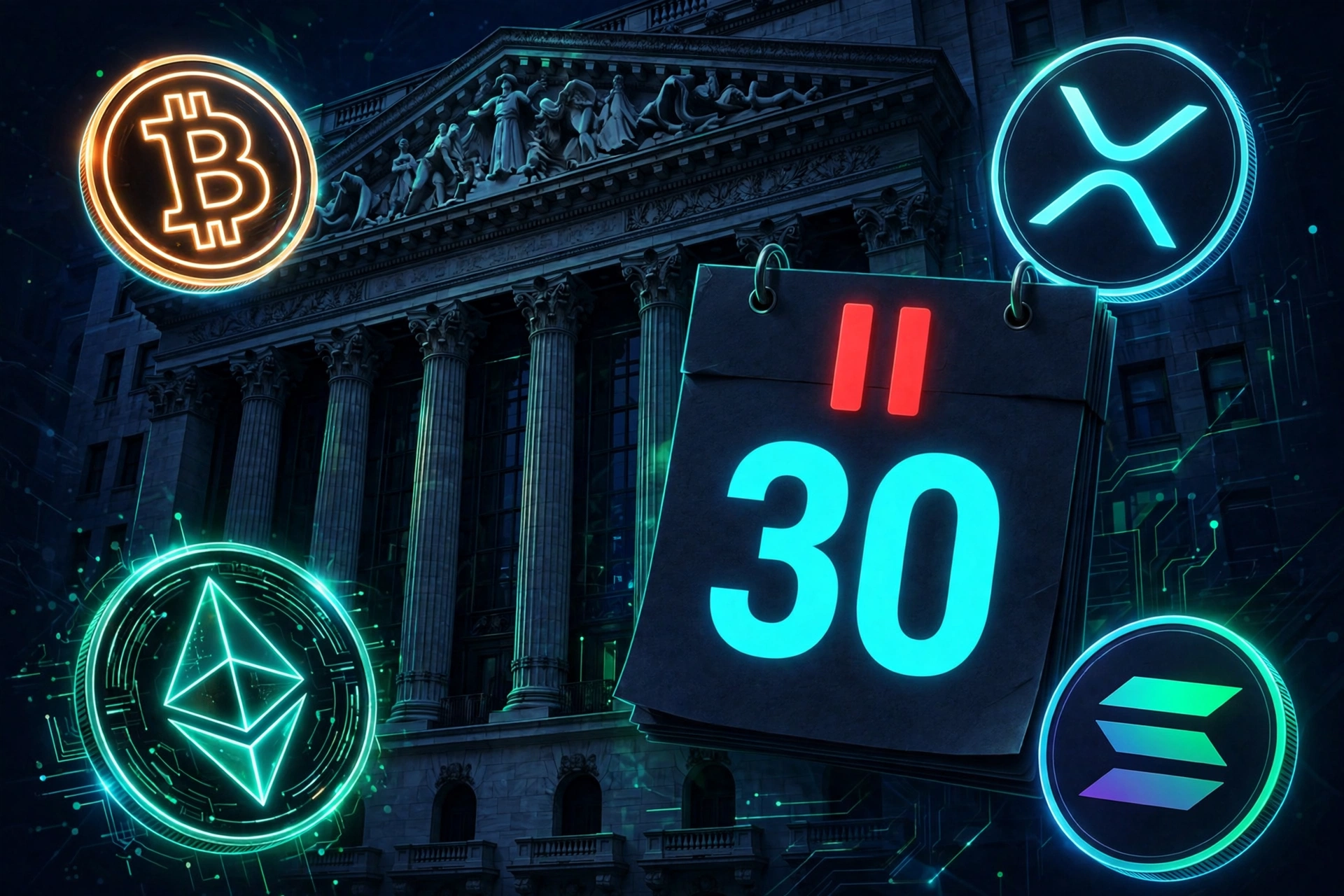
Leveraged XRP, Bitcoin, Ether and Solana ETFs Delayed to November 30 as GraniteShares Files SEC Amendment

Traders waiting for leveraged crypto ETFs will have to wait at least another month. GraniteShares ETF Trust filed an amendment with the US Securities and Exchange Commission on October 26, 2026, pushing the effective date for a suite of leveraged cryptocurrency funds to November 30, 2026. The filing covers 3x Long and 3x Short daily ETFs tied to XRP, Bitcoin, Ether and Solana — four product pairs in total — and it gives no reason for the delay.
The document is strikingly short on explanation. Filed as a post-effective amendment under Rule 485(b) of the Securities Act of 1933, it states that its sole purpose is to delay the effectiveness of a previously filed amendment until November 30. GraniteShares ETF Trust President William Rhind signed the filing on the same day it was submitted. It does not mention the US midterm elections, which fall on November 3 — just weeks before the new effective date — and it does not say whether market conditions, regulatory feedback or internal timing drove the decision.
That silence matters, because the mechanism matters. A Rule 485(b) amendment is a procedural tool: it lets an issuer move the effective date of a registration change without triggering a full SEC review. This is not an SEC denial, an SEC approval, or an adjudicative order. The regulator has not blocked these products; the issuer has voluntarily deferred its own timeline. And because November 30 is an issuer-set date, not a regulator-imposed deadline, GraniteShares could file another amendment to push it further if conditions warrant — or let the amendment take effect on the rescheduled date.
What is being delayed, and why leverage changes the stakes
The delayed lineup is not a set of plain spot ETFs. Daily leveraged ETFs aim to deliver three times the daily return — or three times the inverse daily return — of their underlying asset, resetting every day. That daily reset means they are designed for short holding periods: over days and weeks, compounding can pull their performance far away from three times the asset's longer-term move, in either direction.
In a week like this one, that distinction is the whole story. Bitcoin traded around $77,377 to $78,629 on October 30 after falling to an intraday low near $76,301, Ether sat near $2,232 to $2,250, and the Fear and Greed Index sat in fear territory around 36 to 38, following the roughly $6.3 billion Binance security breach. A 3x product in that tape does not just amplify a view — it amplifies every intraday swing, including the ones driven by headlines rather than fundamentals. For XRP specifically, the asset was trading around $1.30 at the time of the filing, with a market capitalisation near $82.2 billion and 24-hour volume near $1.35 billion — liquid enough to trade, volatile enough that triple leverage is a different risk from holding the token itself.
The delay also lands in a market where the plain-vanilla ETF story has already moved on. Spot XRP ETFs were approved in January 2026, with first trading on January 10, after Bitcoin spot ETFs in early 2024 and Ethereum ETFs later that year. Leveraged products are the next, sharper edge of that same pipeline: they do not open crypto to new investors the way spot funds did, they give existing traders a more aggressive tool. A delay to that tool is therefore not a verdict on crypto adoption — it is a pause on one high-risk product line.
The calendar: November 3, then November 30
Two dates now frame the wait. The first is November 3, the US midterm elections, which will reshape the Congress that writes crypto market-structure law. The filing makes no connection to the elections, and no connection should be assumed — but the timing means any further GraniteShares filing, and any SEC posture toward leveraged crypto products, will land in a post-election political landscape. The second date is November 30 itself, the new effective date. Investors watching it should watch for one specific signal: another 485(b) amendment pushing it again would tell the market the delay is structural, while silence until November 30 would suggest the products simply needed more time.
There is also a broader lesson in how this delay arrived. Crypto ETF launches in 2026 have repeatedly hinged on procedure rather than drama — automatic effectiveness windows, listing-standard changes, and now a one-purpose amendment that moves a date by a month. Traders who read every delay as a regulatory crackdown, or every effective date as an endorsement, will misread both. The filing says exactly one thing: not yet.
For now, the leveraged XRP, Bitcoin, Ether and Solana funds remain on hold. The question for November is not whether leverage demand exists — in a fearful, headline-driven market it plainly does — but whether the issuer, the market and the post-election regulatory climate are ready for triple leverage on four of crypto's most volatile assets at the same time.
Read more on Zimbuck: https://zimbuck.com/pages/zimbucknews and join the discussion at https://zimbuck.com/groups/zimbuckmarketnews . Related reading on the site: https://zimbuck.com/blogs/523/After-the-6-3B-Binance-Hack-Washington-Offers-Crypto-Exchanges
FAQ — What did GraniteShares file? A post-effective amendment with the SEC on October 26, 2026, pushing the effective date for its leveraged crypto ETFs to November 30, 2026.
Which products are delayed? 3x Long and 3x Short daily ETFs tied to XRP, Bitcoin, Ether and Solana — four product pairs in total.
Did the SEC block these ETFs? No — this is an issuer delay under Rule 485(b), not an SEC denial or approval; the filing's stated sole purpose is to delay effectiveness.
Why was the date moved? The filing gives no reason and does not mention the November 3 US midterm elections.
Can the date move again? Yes — November 30 is issuer-set, and GraniteShares could file another amendment to push it further.
How is a 3x daily ETF different from holding the token? It targets three times the daily move and resets daily, so compounding over longer periods can diverge sharply from three times the token's longer-term return.
Is this the same as the spot XRP ETF story? No — spot XRP ETFs were approved in January 2026 with first trading January 10; this delay concerns separate leveraged products.
This article is market news and general information only, not financial advice.




