


How to Swap Crypto on a Decentralized Exchange (DEX): Slippage, Liquidity Pools and Gas — A Beginner's Guide

A decentralized exchange lets you swap crypto straight from your own wallet, with no account, no deposit and no company holding your coins — but the price you get is set by a pool of tokens, not by another trader, and that changes everything about how a trade works. On a centralised exchange, you deposit coins, place an order, and the exchange matches you with another trader. On a decentralized exchange (DEX), there is no deposit and no order book to wait on. Instead, you connect a self-custody wallet, pick two tokens, and trade against a liquidity pool — a smart contract holding reserves of both tokens, supplied by other users. The trade executes immediately, at a price the pool's formula calculates from the ratio of its reserves. That is the whole idea, and it is worth understanding before your first swap, because the three costs that surprise beginners — slippage, price impact and gas — all come from this design. Decentralized trading is not a small corner of crypto: total DeFi value locked stood at about $81.55 billion on November 3, 2026, with $6.386 billion in 24-hour DEX volume, according to DefiLlama figures. This guide walks through a swap the way it actually happens, step by step.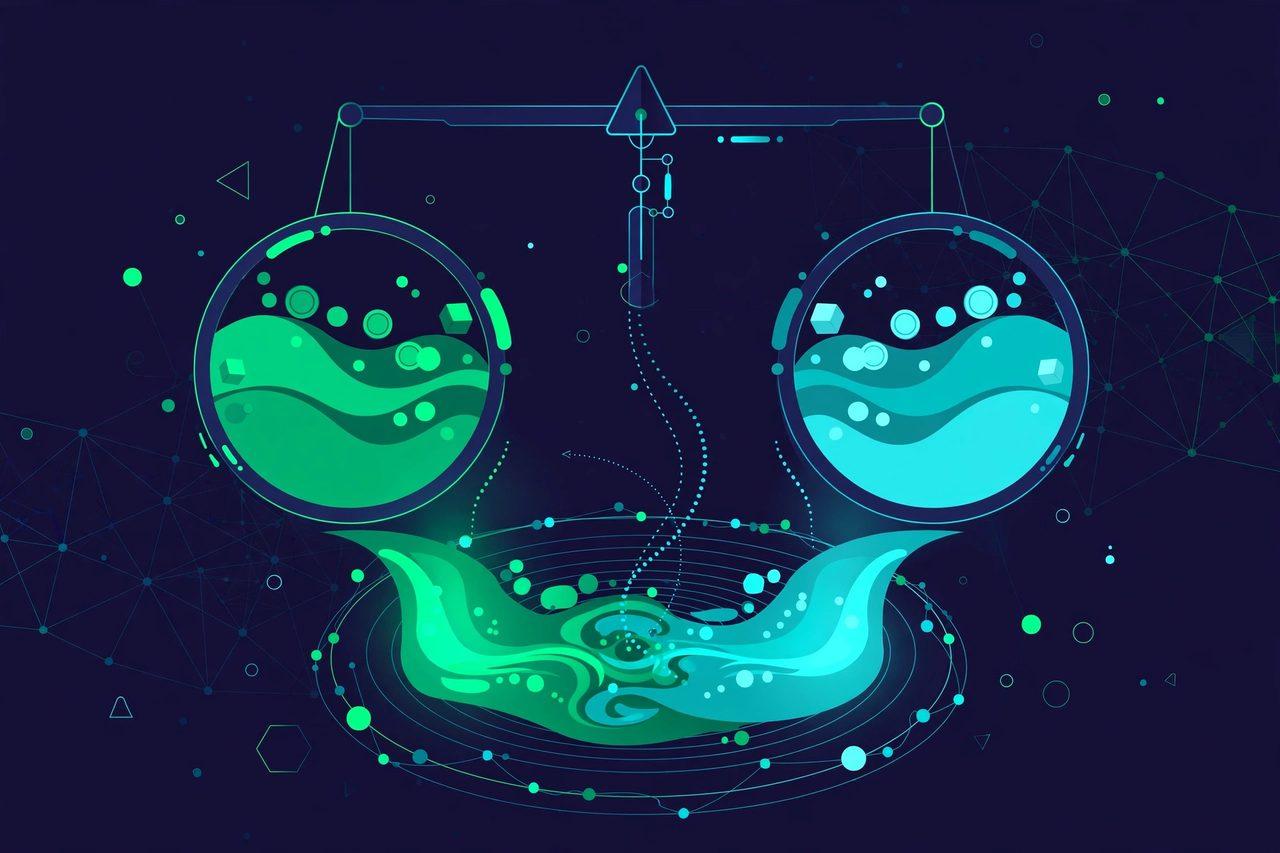 1. How the price is set: pools, not order books. A DEX price comes from an automated market maker (AMM). In the classic design, a pool holds two tokens, x and y, and keeps their product constant: x × y = k. When you buy token A from the pool, you add token B and remove token A, so A becomes scarcer in the pool and its price rises — automatically, with no human setting it. Two consequences follow. First, a small trade in a deep pool barely moves the price; a large trade in a thin pool moves it a lot. That movement is price impact. Second, the price you see quoted is the price at the moment of quoting, not a promise: if the market moves while your transaction waits to be confirmed, the executed price can differ. That difference is slippage, and your slippage tolerance is the maximum difference you accept before the transaction fails rather than executes at a bad price. Later designs improved on the basic formula: Uniswap v3, launched in May 2021, introduced concentrated liquidity, letting liquidity providers choose the price range where their tokens support trading, and its original fee tiers were 0.05%, 0.30% and 1%. For a beginner, the practical rule is simple: check the pool's depth before you trade, and never set a slippage tolerance you would regret if the whole of it were used.
2. A first swap, step by step
A careful first swap looks like this, in order: Use a wallet you control, on the right network. MetaMask, WalletConnect-compatible wallets and Coinbase Wallet are common choices. Confirm the network (Ethereum, an Ethereum Layer-2, Solana, or another chain) matches the DEX and the token version you hold — a token on the wrong network is the most common beginner loss, and it is usually unrecoverable. Check the token contract, not just the name. Anyone can create a token called almost anything. Verify the contract address from the project's official site or a trusted listing before you swap, and be suspicious of a token whose name matches a famous coin but whose contract you cannot verify. Approve only what you need. Your first swap of a token usually asks you to approve the DEX contract to spend it. Approving an unlimited amount is convenient and risky: it lets that contract move that token later without asking again. Prefer a limited approval for the amount you are swapping, and review old approvals regularly. Read the quote before confirming. The screen shows the amount you will receive, the pool fee, the estimated network fee (gas), the price impact and the minimum received after slippage. If the price impact is high, shrink the trade or pick a deeper pool. Confirm, then wait for the chain. The swap is not done when you click confirm; it is done when the blockchain confirms the transaction. Do not re-submit because the screen is slow — a duplicate submission can mean a duplicate trade.
3. The three costs, and how to keep each one small
Every DEX swap has three costs, from three different places, and confusing them is how beginners overpay: Pool fee — a percentage of the trade (for example 0.05%, 0.30% or 1% on Uniswap v3 pools) that goes to the liquidity providers who supplied the pool. Stablecoin-to-stablecoin pools usually charge the lowest tier; volatile pairs charge more. Gas — the network fee paid to validators or sequencers for processing the transaction, not to the DEX. Gas is priced in the chain's native token, it rises when the network is busy, and it is charged even if a transaction fails. On a busy Ethereum day, gas can exceed the pool fee; on a Layer-2, it is usually far smaller. That is why the same swap can cost very different amounts on different networks. Slippage and price impact — the execution cost described above. It is small in deep pools and punishing in thin ones. Aggregators such as 1inch (Ethereum and EVM-compatible chains) and Jupiter (Solana) help here: they split a trade across several pools and return the best combined execution, and for larger trades they almost always beat a single pool.
4. The risks no interface warns you about clearly
A DEX gives you custody of your own assets, which means it also gives you the risks a centralised exchange used to absorb. Fake tokens and copycat contracts are the first risk — always verify the contract address. Unlimited approvals are the second — audit and revoke them, a subject our token-approval guide covers in detail. Impermanent loss is the third, for anyone tempted to supply liquidity rather than just swap: when the two tokens in a pool move apart in price, withdrawing can leave you with less than simply holding both tokens would have, and trading fees may or may not cover the gap. Smart-contract bugs are the fourth: a pool's code is the exchange, and audited, long-running pools are a safer first choice than a brand-new pool promising extreme returns. Finally, front-running (MEV) can move the price against you between quoting and confirmation on busy chains; a sensible slippage tolerance and a reputable interface are the basic defences. Start small, on a well-known DEX, with a token you have verified, on a network you understand — and treat your first swap as a paid lesson, not as a trade that has to win.
FAQ
What is the difference between a DEX and a centralised exchange? A centralised exchange holds your deposits and matches orders on its own order book. A DEX swaps through smart-contract pools from your own wallet, with no deposit and no company custody. What is slippage? The difference between the quoted price and the executed price, caused by market movement or the trade's own price impact while the transaction waits for confirmation. What is price impact? How much your own trade moves the pool's price. It grows as your trade grows relative to the pool's liquidity. What is gas? The network fee for processing your transaction, paid in the chain's native token to validators or sequencers — separate from the DEX pool fee. Do I need to approve a token before swapping? Usually yes, once per token per DEX contract. Prefer a limited approval for the amount you are swapping rather than an unlimited one. Is a DEX safer than a centralised exchange? It removes exchange-custody risk, but adds self-custody risk: you alone are responsible for the contract address, the network, the approval and the wallet. Neither is risk-free.
Our token-approval guide is here: https://zimbuck.com/blogs/801/How-to-Check-a-Token-Approval-Before-You-Sign-It — and our impermanent-loss explainer is here: https://zimbuck.com/blogs/946/Impermanent-Loss-Explained-Why-Providing-Liquidity-Can-Lose-Money-Even — plus the Zimbuck News page here: https://zimbuck.com/pages/zimbucknews with discussion at https://zimbuck.com/groups/zimbuckmarketnews . The latest DeFi totals quoted above are here: https://defillama.com/ . This is general educational information only, not financial advice. Join Zimbuck at https://zimbuck.com to follow more crypto learning guides.




