

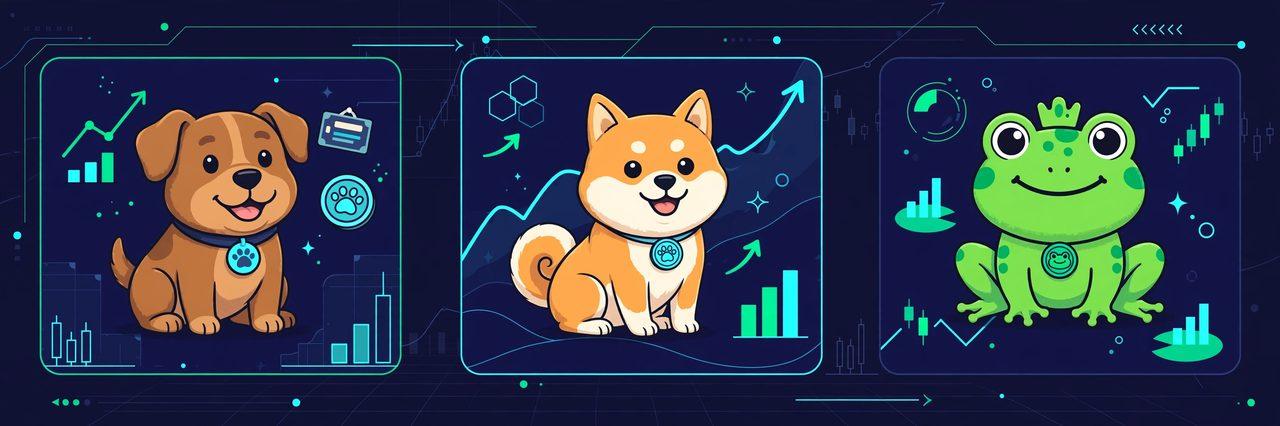
Dogecoin vs Shiba Inu vs Pepe: What Actually Makes the Big Three Memecoins Different?

Dogecoin, Shiba Inu and Pepe are all called memecoins, but they are not three versions of the same thing — one is a payment coin with its own chain, one is an ecosystem token, and one is a pure meme bet, and buying them as if they were interchangeable is the beginner mistake this guide exists to prevent. Memecoins are routinely lumped together as "joke coins," yet the three largest by market value behave very differently, and the numbers prove it. On November 2, 2026, the three leaders by market capitalisation were Dogecoin at $11.8 billion, Shiba Inu at $2.70 billion and Pepe at $2.04 billion, with 66 coins tracked in total. Their prices that day were DOGE $0.07423, SHIB $0.00000457 and PEPE $0.00000478. Over the previous seven days, Pepe was up 10.6% while Dogecoin fell 4.6% and Shiba Inu fell 6.5%. Same label, opposite weeks. Understanding why starts with what each coin actually is, not with its mascot.

- Three origins, three designs
Dogecoin (DOGE) is the original memecoin, launched in 2013 as a joke built on a friendly Shiba Inu dog meme — and it is the only one of the three with its own blockchain. It works as a payment coin: fast, cheap transfers, a large and long-lived community, and merchant and tipping use that no other memecoin has matched. Its price per coin looks low, but that is arithmetic, not cheapness: there are billions of DOGE in circulation, so a low unit price still adds up to an $11.8 billion market value. Shiba Inu (SHIB) arrived in 2020 as an Ethereum token explicitly positioned as a "Dogecoin killer," and it grew into an ecosystem play rather than a single coin: a token with related tokens, a swap platform and community projects around it. Its value case rests on that ecosystem and on its community's burn and development activity, not on being a payment chain — it rides on Ethereum instead of running its own network. Pepe (PEPE) launched in 2023 as the purest meme of the three: an Ethereum token with no pretence of utility, no ecosystem roadmap as its selling point, and a value driven almost entirely by attention, sentiment and trading momentum. That honesty about what it is matters, because it tells you what to watch: not development milestones, but social attention, exchange flows and whale wallets.
2. What the recent numbers actually show
The last week is a clean demonstration of the differences: Pepe led, and violently. Pepe rose about 5% to 15% over seven days depending on the data provider and measurement window, with a sharp one-day jump of roughly 15% on Friday even as the wider market sold off after the Binance hack — and a wallet linked to that hack dumped 7.77 trillion PEPE, about $32 million, yet Pepe still rose about 8.5% in 24 hours, because the sale was only about 1.5% of daily trading volume. Momentum, not fundamentals, absorbed a hacker dump. Pepe's trading volume dwarfs Shiba Inu's. On October 30, Pepe's daily trading volume was $1.457 billion, about 16.4 times Shiba Inu's $88.9 million, even though Shiba Inu had the larger market capitalisation that day ($2.731 billion vs $1.916 billion). Volume is where traders are; market capitalisation is where holders sit. Pepe is a trader's coin; Shiba Inu, by this measure, is a holder's coin. Dogecoin went quiet — and that is its own signal. Dogecoin fell to a 74-day low even as its network produced only 1,356 blocks in the 24 hours to October 28, against a target of 1,440 (one per minute) — 84 blocks short, about 5.83%. Slower block production trims new supply, but it did not lift the price: in a risk-off week, the oldest memecoin offered no shelter, and both Dogecoin and Shiba Inu sat below their 50-day and 200-day trend lines while Pepe traded above its own.

3. How to compare memecoins without fooling yourself
Four checks separate a comparison from a guess: Compare market capitalisation, never unit price. A coin at $0.00000478 is not "cheaper" than one at $0.07423 — what matters is price multiplied by circulating supply. Pepe at $2.04 billion is a smaller bet than Dogecoin at $11.8 billion, whatever the decimals suggest. Ask what would have to be true for it to rise. Dogecoin needs payment adoption or a community revival; Shiba Inu needs its ecosystem to keep shipping; Pepe needs attention to keep arriving. If you cannot name the driver, you are buying a chart, not a thesis. Check volume against market value. High volume with a smaller market value (Pepe vs Shiba Inu on October 30) means fast, trader-driven moves in both directions. Low volume with a large market value means a price that can gap when a big holder moves. Size for volatility, not for hope. Memecoins routinely move double digits in a day on no news at all. A position that feels exciting at purchase and terrifying at the first 20% drop was sized wrong, whatever the coin. Never fund a memecoin position with money needed soon, and never confuse a community's enthusiasm with a guarantee — communities are loudest exactly when prices are most fragile.
FAQ
Which of the three is the "safest" memecoin? None is safe in the ordinary sense. Dogecoin is the oldest and most liquid, Shiba Inu has the broadest ecosystem, Pepe has the strongest recent momentum — each strength comes with its own risk, and all three can fall sharply on sentiment alone. Why is Pepe's price so small if it is worth $2 billion? Because there are hundreds of trillions of PEPE tokens. Market value is price times supply, so a tiny unit price with a huge supply still adds up to billions. Does high trading volume mean a coin is strong? It means it is active, not that it is sound. Pepe's volume was 16.4 times Shiba Inu's on October 30 — that activity cuts both ways, up and down. Can Dogecoin's slower block production push its price up? Slower production trims new supply, but supply is only one input. In the week measured, Dogecoin still fell to a 74-day low despite producing fewer blocks than targeted. Should beginners start with the biggest memecoin? Starting with the most liquid, best-understood coin is the less reckless choice — but "less reckless" is not "safe," and position size matters more than which of the three you pick.
Our PEPE hacker-dump news coverage is here: https://zimbuck.com/blogs/945/PEPE-Absorbs-a-32-Million-Dump-and-Still-Rises-7 — and the Zimbuck News page is here: https://zimbuck.com/pages/zimbucknews with discussion at https://zimbuck.com/groups/zimbuckmarketnews . The November memecoin market-capitalisation table quoted above is here: https://www.sectoralpha.in/meme-coins . This is general educational information only, not financial advice. Join Zimbuck at https://zimbuck.com to follow more memecoin coverage.




