

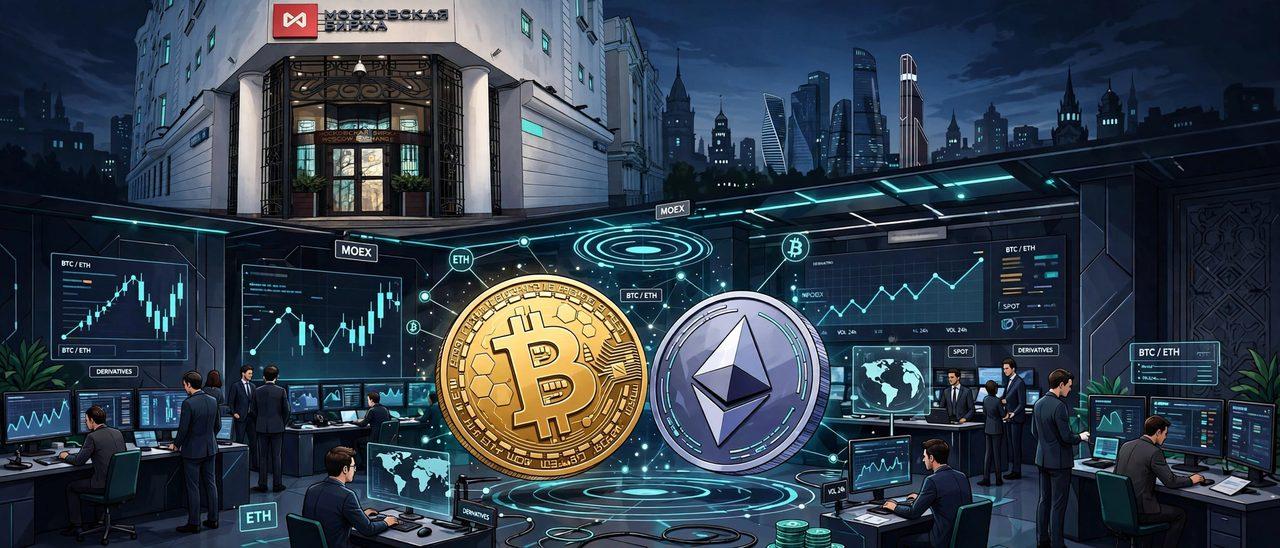
Moscow Exchange to Launch Bitcoin, Ether and USDT Trading on December 1 — Russia's First Organized Crypto Market

Russia's biggest stock exchange is about to trade crypto: Moscow Exchange plans to open Bitcoin, Ether and USDT trading on December 1, 2026, in what it describes as the country's first organized digital currency market.
The announcement, reported on November 3, 2026, is one of the clearest signs yet of how Russia's regulated crypto experiment is taking shape. Moscow Exchange said pilot trades would begin as participants join the platform, using its existing stock-market infrastructure and clearing through the National Clearing Center (NCC). Trading hours will run from 6:50 a.m. to 11:50 p.m. Moscow time. Initially the venue will support same-day and next-day settlement, as well as swap transactions for liquidity management. Only three assets make the cut at launch: Bitcoin (BTC), Ether (ETH) and Tether's USDT — chosen, the exchange said, because they meet the regulator's criteria for non-qualified investors. That narrow list is itself the story: this is not a free-for-all crypto exchange, it is a tightly fenced, exchange-grade market built on top of a traditional bourse .
1. How the new market will actually work
Access will come through professional market participants — in practice, brokers — rather than direct retail accounts on the exchange. Trades will be cleared through the NCC, the same clearing house that handles the exchange's stock-market trades, which is meant to give the new market the same settlement discipline as equities. Same-day (TOD) and next-day (TOM) settlement will be available from the start, with swaps alongside them so participants can manage liquidity. The venue's hours — almost 17 hours a day, from early morning to late evening Moscow time — are far longer than a normal stock session, reflecting crypto's near-round-the-clock character while still stopping short of 24/7 trading. For traders used to crypto exchanges that never close, that is a meaningful difference: positions cannot simply be adjusted at 3 a.m. on this venue. For traditional investors, it is the opposite signal — crypto, traded with stock-market plumbing.
2. The retail rules: a test, and a 300,000-ruble cap
The most important detail for ordinary investors is the restriction on non-qualified investors. They must pass a test before purchasing crypto, and their purchases will be limited to 300,000 rubles — about $3,700 — annually per broker. That cap is small by design, and it changes how the launch should be read. It is not an invitation for mass retail speculation; it is a controlled on-ramp, with the test acting as a knowledge gate and the cap acting as a loss limiter. Qualified investors face no such stated cap in the reporting, which creates a two-tier market from day one: professionals and qualified participants can trade in size, while retail participation is deliberately throttled. Anyone writing about this launch as "Russia opens crypto to everyone" is getting it wrong — the rules say the opposite, at least for the first phase.
3. The legal backdrop — and the sanctions problem
The launch rests on a Russian crypto law whose main provisions took effect on September 1, 2026. That law permits regulated trading, but it maintains a ban on cryptocurrency payments for goods and services in Russia — crypto as a tradable asset, yes; crypto as money at the till, no. That distinction matters for every claim about adoption that follows this story. At the same time, both Moscow Exchange and the NCC have been under US sanctions since June 2024, with the UK also sanctioning the exchange and the European Union adding it to its sanctions list in July 2026. That limits who can realistically participate: international institutions subject to those sanctions regimes cannot simply route orders through a sanctioned venue, however interesting the market looks. For Russian domestic users, the launch is another legal route to buy BTC and ETH at a time when some international exchanges have closed to Russian clients — but the ruble-denominated, domestic-market design means it is a walled garden, not a bridge to global liqu idity.
4. What this means — and what it does not
Three readings are worth holding at once. First, for market structure, a major national stock exchange running an organized crypto market is a genuine milestone: it puts BTC, ETH and USDT inside the same infrastructure, clearing and surveillance world as equities, rather than leaving them entirely to offshore crypto-native venues. Second, for Russian users, it is a regulated alternative with real constraints — a test, a $3,700-equivalent annual retail cap per broker, and no payments use — so it should not be confused with the permissionless crypto market. Third, for the rest of the world, the sanctions overlay means the direct spillover is limited; the more interesting signal is precedent. Other jurisdictions watching how a traditional exchange absorbs crypto trading will note both halves of the design: the institutional-grade plumbing, and the retail guardrails. If the pilot trades go smoothly in December, expect the debate to shift from "will stock exchanges trade crypto?" to "on what terms, for whom, and with what caps?" — which is exactly the debate regulators everywhere are already having. What to watch next: whether pilot participation is broad or limited to a handful of brokers, whether the retail cap is raised after an initial period, and whether any further assets are added beyond BTC, ETH and USDT.
FAQ
When does Moscow Exchange start crypto trading? December 1, 2026, with pilot trades beginning as participants join.
Which cryptocurrencies will trade at launch? Bitcoin, Ether and Tether's USDT only.
Can any retail investor buy? Non-qualified investors must pass a test first and are limited to 300,000 rubles (about $3,700) per broker per year.
Can crypto be used to pay for goods in Russia under this law? No — the law permits regulated trading but maintains the ban on crypto payments for goods and services.
Why might international traders stay away? Moscow Exchange and its clearing house are under US, UK and EU sanctions, which restricts participation for sanctions-bound institutions.
Is this the same as trading on a crypto exchange? No — it uses stock-market infrastructure and central clearing, runs limited hours (6:50 a.m. to 11:50 p.m. Moscow time), and starts with only three assets.
Our related exchange coverage is here: https://zimbuck.com/blogs/930/Exchanges-Tightened-Access-on-November-2-Coinbase-s-AERO-Migration — and the Zimbuck News page is here: https://zimbuck.com/pages/zimbucknews with discussion at https://zimbuck.com/groups/zimbuckmarketnews . The Moscow Exchange announcement as reported is here: https://cointelegraph.com/news/moscow-exchange-bitcoin-ether-usdt-trading-december . This is market news and general information only, not financial advice. Join Zimbuck at https://zimbuck.com to follow more crypto exchange coverage.




