English
 Arabic
 French
 Spanish
 Portuguese
 Deutsch
 Turkish
 Dutch
Dutch
 Italiano
 Russian
 Romaian
 Portuguese (Brazil)
 Greek
Greek

Why First-Time Luxury Buyers Choose Amiri Jeans: A Beginner’s Guide to Premium Denim
Shopping |
2026-06-10 09:16:05
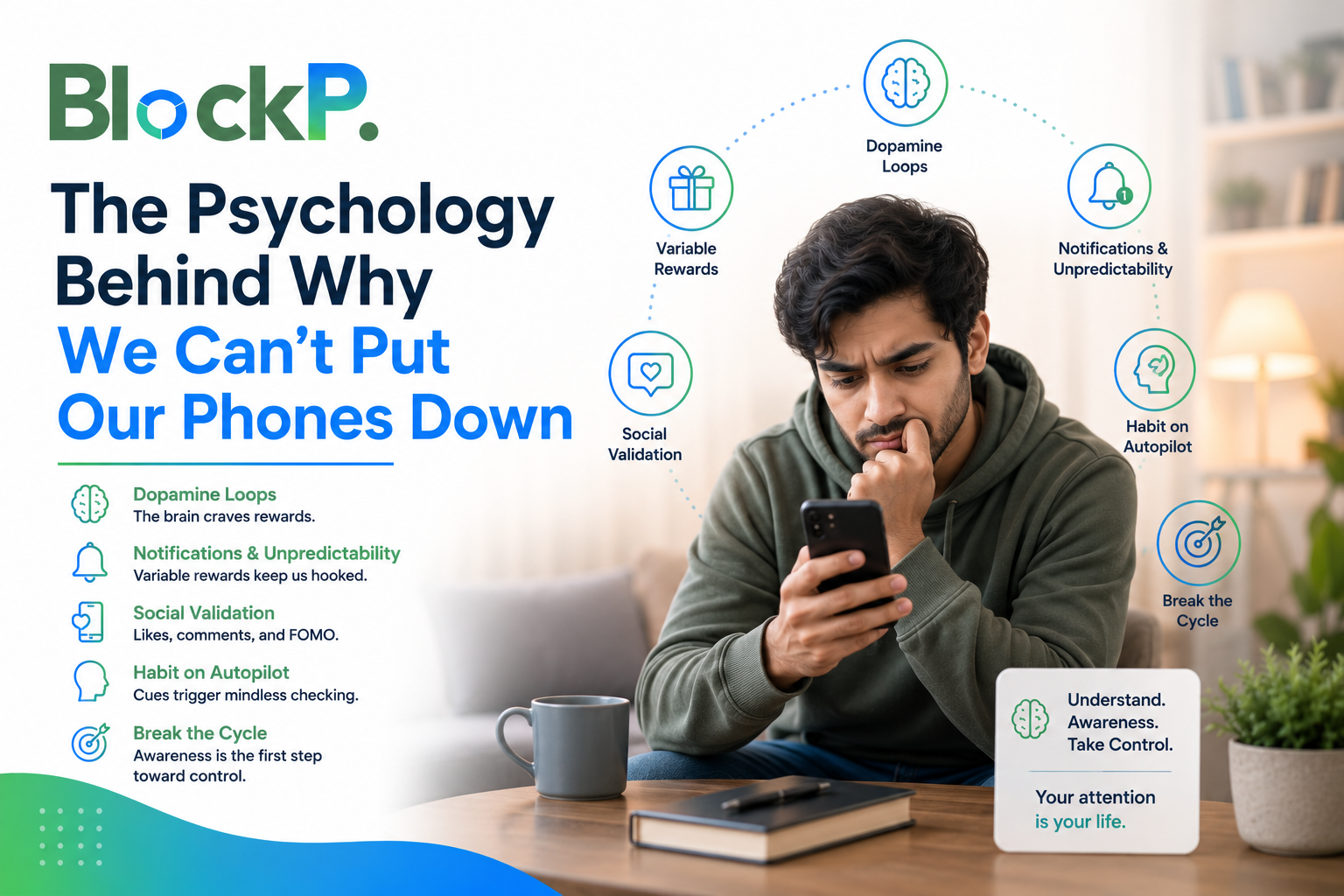
Walk into a coffee shop, airport, classroom, or waiting room, and you'll likely see the same scene: people looking down at their phones. Many of us check our devices dozens, sometimes hundreds, of times per day. We unlock them while standing in line, during conversations, before bed, and often within minutes of waking up.
Most people recognize this habit. Many have even experienced the strange feeling of picking up their phone without consciously deciding to do so. What starts as a quick glance can easily turn into twenty minutes of scrolling.
This raises an important question: why is it so difficult to put our phones down?
The answer is not simply a lack of willpower. Modern apps and digital platforms are built using principles drawn from psychology, behavioral science, and user experience research. Their goal is to capture attention, encourage engagement, and keep users returning repeatedly.
Understanding how these systems work can help people make more informed choices about their technology use and regain greater control over their time and attention.
Smartphones are remarkable tools.
They help us communicate, learn, navigate, work, shop, and stay informed. The problem is not the device itself. The challenge emerges when convenience and engagement become difficult to separate.
Many apps compete for one limited resource:
Your attention.
Because attention drives advertising revenue, subscriptions, and user growth, technology companies invest heavily in understanding what keeps people engaged.
This has led to the development of sophisticated design strategies that encourage repeated use.
One of the most influential concepts in behavioral psychology is the variable reward system.
A variable reward occurs when rewards are delivered unpredictably rather than consistently.
Consider a slot machine.
A player never knows exactly when a reward will arrive. The uncertainty itself becomes engaging.
Many digital experiences use a similar principle.
Examples include:
Each time someone checks their phone, they might discover something interesting—or they might not.
Because the outcome is unpredictable, the brain remains motivated to keep checking.
This pattern can strengthen habitual behavior over time.
Discussions about phone use often mention dopamine.
Dopamine is sometimes described as the brain's "pleasure chemical," but that explanation is incomplete.
Researchers increasingly view dopamine as playing an important role in motivation, learning, and anticipation.
Interestingly, dopamine activity often increases before a reward arrives rather than after.
This means anticipation itself can become highly motivating.
When someone hears a notification sound or sees a badge icon, the brain may begin anticipating a potentially rewarding experience.
That anticipation encourages engagement.
Importantly, dopamine is involved in many healthy activities as well, including learning, exercise, and social connection.
The issue is not dopamine itself but how digital systems can repeatedly trigger reward-seeking behaviors.
One of the most influential design innovations in recent years is infinite scroll.
Instead of reaching a natural stopping point, users can continue consuming content indefinitely.
There is no page break.
No ending.
No signal that says, "You've seen enough."
This design removes natural pauses that might otherwise encourage users to stop and reflect.
As a result, people often spend far more time engaging with content than originally intended.
Many experts view infinite scroll as one of the defining features of the modern attention economy.
Notifications appear harmless.
After all, they simply provide information.
However, from a psychological perspective, notifications serve a powerful purpose: they interrupt attention.
Every notification creates a choice.
Should you continue what you're doing, or should you check your device?
Even when ignored, notifications can create cognitive distraction.
Research on attention suggests that interruptions may reduce focus and increase mental fatigue.
Over time, constant notifications can create a feeling of being perpetually "on call."
Humans are social creatures.
For most of history, belonging to a community was essential for survival.
Many digital platforms leverage this fundamental social motivation.
Features such as:
all provide forms of social feedback.
Social feedback can feel rewarding because it signals connection, approval, or recognition.
The challenge arises when external validation becomes a primary driver of engagement.
In such cases, users may find themselves repeatedly checking apps for updates, reactions, or responses.
Another psychological factor influencing phone use is Fear of Missing Out, often called FOMO.
People naturally want to stay informed and connected.
Social platforms amplify this tendency by providing a constant stream of updates.
Users may worry about missing:
This fear can create pressure to remain connected even when doing so causes stress or distraction.
The result is a cycle where individuals continue checking their devices despite wanting to spend less time on them.
The term "attention economy" refers to the competition for human attention in an environment overflowing with information.
In traditional economies, businesses compete for money.
In the digital economy, many businesses compete for attention.
Attention has become a valuable asset because:
As a result, companies continuously experiment with ways to attract and retain users.
This does not necessarily mean apps are intentionally harmful.
However, it does mean that many digital products are optimized to keep users engaged for as long as possible.
Many people assume that understanding these psychological mechanisms should automatically solve the problem.
Unfortunately, behavior change is rarely that simple.
People often know certain habits are unhelpful while continuing them anyway.
For example:
Knowledge helps, but environments also matter.
Behavioral science consistently shows that habits are influenced by both personal choices and external conditions.
One effective strategy is modifying the environment rather than relying solely on willpower.
Examples include:
Disable alerts that are not essential.
Keep devices away from bedrooms or dining areas.
Build intentional breaks into daily routines.
Making distracting apps slightly harder to access can reduce impulsive use.
Some individuals use tools designed to reduce distractions and support healthier online habits. Solutions such as BlockP can serve as counterbalances to attention-capturing design patterns by helping users create intentional boundaries around specific types of online content.
Technology itself is not the enemy.
Smartphones provide enormous value when used intentionally.
The goal is not necessarily to eliminate technology but to ensure that it serves personal goals rather than constantly competing for attention.
Healthy technology use often involves asking:
Small moments of awareness can gradually lead to meaningful changes.
The reason many people struggle to put their phones down is not simply a matter of self-control. Modern apps are often designed around powerful psychological principles including variable rewards, social validation, infinite scrolling, and attention optimization. These features interact with fundamental aspects of human behavior, making engagement feel natural and sometimes difficult to resist.
Understanding these mechanisms does not require rejecting technology. Instead, it allows individuals to use technology more consciously. By recognizing how digital products compete for attention and by creating healthier boundaries, people can enjoy the benefits of connectivity without feeling controlled by it.
In a world where attention is increasingly valuable, learning to protect it may be one of the most important skills we can develop.
Most app developers aim to increase engagement, retention, and user satisfaction. Features such as notifications, recommendations, and infinite scrolling are often designed to encourage continued use. While not all apps are intentionally designed to be addictive, many are optimized to capture and retain attention.
The attention economy refers to a marketplace where businesses compete for human attention. Since attention often drives advertising revenue and platform growth, digital companies invest heavily in strategies that encourage users to spend more time engaging with their products.
Awareness is an important first step, but it is often not sufficient on its own. Sustainable behavior change typically involves combining awareness with practical strategies such as modifying notifications, setting boundaries, creating healthier routines, and adjusting digital environments to support personal goals.