

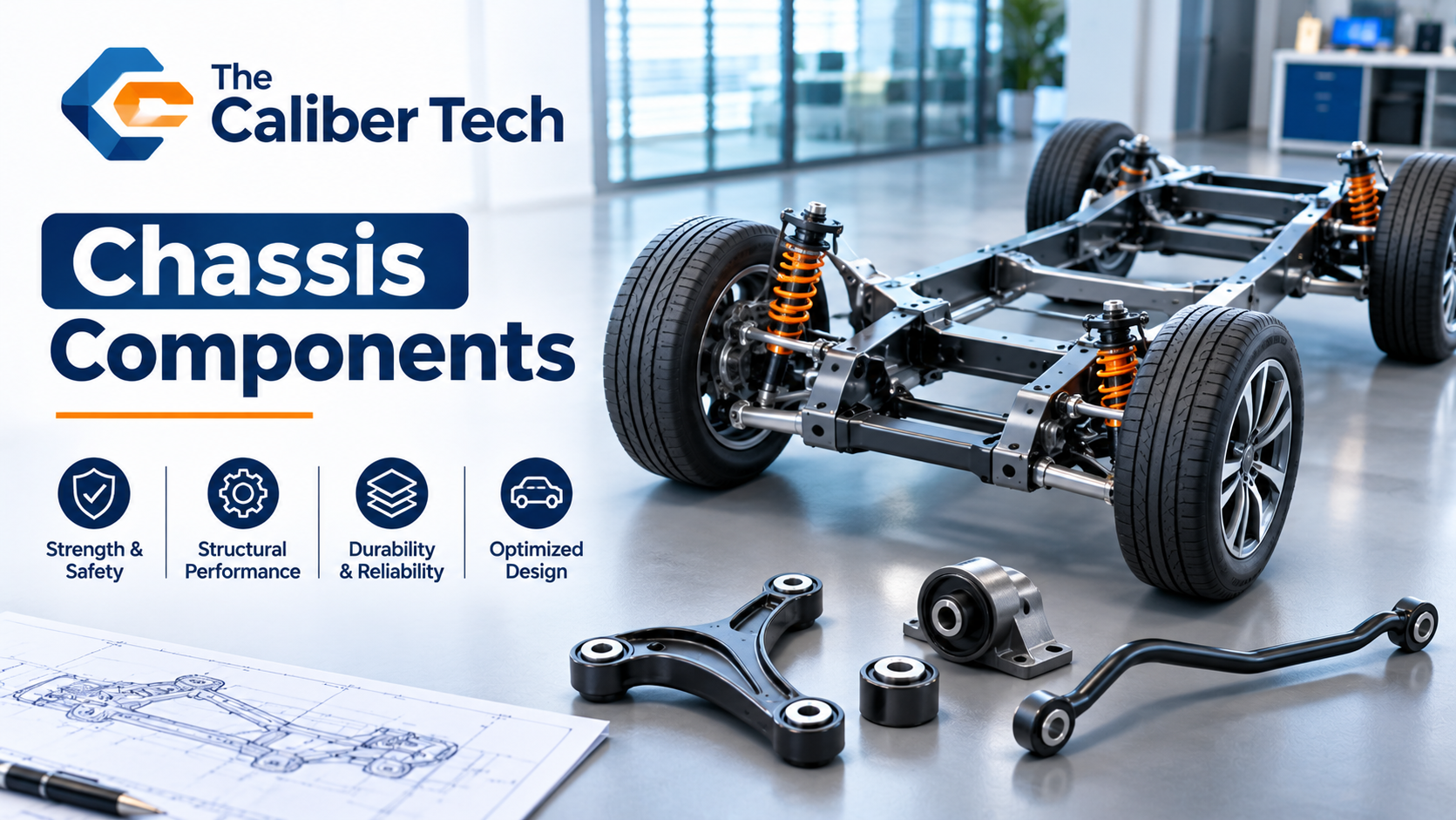

A vehicle must do more than produce engine power. It needs a strong supporting structure, controlled wheel movement, responsive steering, and dependable braking to operate safely. These functions rely on several interconnected chassis components that support the vehicle and manage the forces created during everyday driving. Their design influences how a vehicle handles corners, responds to bumps, carries passengers, and performs under heavy loads.
Although many drivers associate vehicle maintenance mainly with the engine, chassis condition is equally important. A worn suspension joint, damaged mounting bracket, or faulty wheel bearing can affect several connected systems. Understanding the purpose of chassis components helps vehicle owners recognise early warning signs, make informed repair decisions, and maintain reliable performance.
What Does a Vehicle Chassis Include?
The chassis is the structural and mechanical foundation of a vehicle. It supports the powertrain, suspension, steering, braking equipment, and wheels. Depending on the design, it may be a separate frame or an integrated part of the vehicle body.
A chassis must withstand different forces. Acceleration creates torque reactions, braking produces deceleration forces, and cornering transfers weight from one side of the vehicle to another. Uneven roads also create repeated impacts. Engineers design the structure and its supporting parts to manage these loads without excessive deformation.
The arrangement of chassis components varies between passenger cars, SUVs, trucks, buses, and specialised vehicles. However, the main systems perform similar functions.
Major Chassis Components and Their Roles
1. Structural Frame and Mounting Brackets
The frame or integrated body structure provides the foundation for the vehicle. In body-on-frame construction, two main longitudinal rails are connected by crossmembers. This arrangement is common in many commercial vehicles and pickup trucks.
Crossmembers improve rigidity and provide mounting points for mechanical assemblies. Brackets and reinforced sections secure components such as the engine, transmission, suspension, and fuel tank.
Passenger cars often use unibody construction. In this design, structural panels, pillars, floor sections, and reinforced rails work together to carry loads. This approach can reduce weight while providing carefully designed areas for crash-energy management.
Structural damage should never be treated as a cosmetic issue. A bent mounting point can change suspension geometry or prevent a component from operating correctly.
2. Suspension System
The suspension connects the wheels to the vehicle structure. It allows the wheels to move over uneven surfaces while helping maintain tyre contact with the road.
Its main parts include springs, dampers, control arms, joints, and stabilizer bars.
Springs and Shock Absorbers
Springs support vehicle weight and compress when a wheel encounters a bump. Common designs include coil springs, leaf springs, torsion bars, and air springs.
Shock absorbers control spring movement. They prevent repeated bouncing after the suspension compresses or extends. If dampers become weak, the vehicle may feel unstable on rough roads, and tyre contact can become less consistent.
Control Arms and Stabilizer Bars
Control arms guide wheel movement and help maintain suspension geometry. Their joints and bushings allow controlled movement while limiting unwanted vibration.
A stabilizer bar connects suspension assemblies across the vehicle. During cornering, it helps reduce the difference in suspension movement between the two sides, limiting excessive body roll.
3. Steering Mechanism
The steering system converts driver input into directional movement of the wheels. A typical rack-and-pinion system includes a steering column, pinion gear, rack, tie rods, and steering knuckles.
When the driver turns the steering wheel, the pinion moves the rack from side to side. Tie rods transfer this movement to the steering knuckles, which turn the wheels.
Many modern vehicles use electric power steering. An electric motor provides assistance based on steering input and vehicle operating conditions. Some older or specialised designs use hydraulic assistance.
Loose steering joints, damaged tie rods, or worn rack connections can cause excessive play, vibration, or poor directional control. These faults require prompt inspection.
4. Braking System
The braking system controls vehicle speed and provides the force needed to stop. Most modern vehicles use hydraulic disc brakes, although drum brakes remain common in some applications.
A disc brake assembly consists of a rotor, caliper, and brake pads. Hydraulic pressure moves the pads against the rotor, creating friction that slows wheel rotation.
In a drum brake, brake shoes press against the inside of a rotating drum. Other important parts include the master cylinder, brake booster, brake lines, and fluid reservoir.
Electronic systems also contribute to braking control. The anti-lock braking system (ABS) monitors wheel speed and adjusts brake pressure to help prevent wheel lock during hard braking. Electronic stability control can use selective braking to help manage vehicle direction during certain loss-of-control situations.
Brake fluid, pads, discs, hoses, and connections need regular checks. A soft pedal, grinding noise, or increased stopping distance should not be ignored.
5. Wheel Hubs and Bearings
The wheel hub provides the connection between the wheel and the vehicle's axle or suspension assembly. It also supports the wheel bearing.
Bearings allow the wheel to rotate with minimal friction while carrying radial and axial loads. Many modern vehicles use sealed bearing units that are replaced as complete assemblies when damaged.
A failing wheel bearing may produce a humming or rumbling sound that changes with speed or when the vehicle turns. Excessive bearing play can affect wheel stability, so diagnosis should not be delayed.
6. Axles, Driveshafts, and Differentials
These components transfer and distribute engine power to the driving wheels.
An axle may support wheel loads, transmit torque, or perform both functions, depending on the vehicle layout. Front-wheel-drive vehicles commonly use driveshafts with constant-velocity joints. These joints transfer power while allowing the wheels to steer and move with the suspension.
Rear-wheel-drive vehicles often use a driveshaft to connect the transmission to the rear differential. The differential distributes torque between the wheels and allows them to rotate at different speeds when cornering.
Worn CV joints may produce clicking sounds during tight turns. Damaged universal joints can cause vibration, while differential problems may create whining noises under acceleration or deceleration.
Materials and Manufacturing of Chassis Components
Material selection affects strength, weight, durability, cost, and production efficiency.
Steel is widely used for structural members and suspension parts because of its strength and established manufacturing processes. High-strength steel allows engineers to achieve required stiffness and strength with carefully designed sections.
Aluminium alloys are used in selected control arms, subframes, and structural parts to reduce weight. Their lower density can support vehicle efficiency, although manufacturing and repair methods differ from those used for steel.
Some specialist applications use composite materials where weight reduction and specific mechanical properties justify the additional cost.
Manufacturers use processes such as stamping, casting, forging, welding, and machining. Components are tested for dimensional accuracy, strength, fatigue resistance, and durability. Computer-aided engineering can help identify stress concentrations before physical prototypes are tested.
Practical Benefits of Well-Maintained Chassis Components
Maintaining chassis components provides benefits beyond preventing mechanical failure.
-
Predictable handling: Sound steering and suspension parts help the vehicle respond consistently to driver input.
-
Reliable braking: Properly maintained brake assemblies support controlled stopping distances.
-
Better ride quality: Springs, dampers, and bushings reduce harsh movement and vibration.
-
Even tyre wear: Correct alignment and healthy suspension joints help maintain suitable tyre contact.
-
Longer service life: Early repairs can prevent damaged parts from placing extra stress on connected assemblies.
-
Improved load support: Sound structural members and suspension parts help the vehicle carry its intended weight safely.
These benefits depend on correct installation and maintenance. Using unsuitable replacement parts or ignoring manufacturer specifications can affect vehicle performance.
Common Chassis Problems and Considerations
Corrosion and Environmental Exposure
Water, road salt, mud, and damaged protective coatings can cause corrosion. Rust may affect frame sections, fasteners, brake lines, and suspension mounting points. Vehicles regularly exposed to moisture or coastal conditions may need more frequent inspections.
Mechanical Wear
Bushings, ball joints, bearings, and steering connections wear through repeated movement. Heavy loads and rough roads can accelerate this process. Drivers may notice knocking noises, vibration, loose steering, or uneven tyre wear.
Collision and Road Impact Damage
A collision or severe pothole impact can bend suspension arms, damage wheels, or alter structural alignment. A vehicle may continue moving even when important parts are no longer correctly positioned. Professional inspection is necessary after significant impact damage.
Incorrect Repairs
Installing the wrong component, tightening fasteners incorrectly, or ignoring alignment requirements can create further problems. Repairs should follow the vehicle manufacturer's procedures and torque specifications.
Frequently Asked Questions
1. What are the primary chassis components in a car?
They generally include the frame or unibody structure, suspension, steering, braking system, axles, wheel hubs, bearings, and drivetrain connections.
2. Are chassis components the same in every vehicle?
No. Their design depends on vehicle size, weight, drivetrain, purpose, and construction method. A commercial truck has different structural requirements from a small passenger car.
3. How can I tell if a chassis component is damaged?
Warning signs include knocking noises, unusual vibration, uneven tyre wear, excessive bouncing, steering difficulty, and changes in braking behaviour.
4. Do chassis components affect fuel efficiency?
They can. Excessive vehicle weight, dragging brakes, incorrect wheel alignment, and certain mechanical faults may increase energy consumption.
5. How can chassis components last longer?
Follow the manufacturer's service schedule, avoid overloading, inspect the vehicle after severe impacts, maintain correct tyre pressure, and repair worn or damaged parts promptly.
Conclusion
Chassis components work together to provide the structure, control, and support required for safe vehicle operation. The frame carries loads, suspension manages wheel movement, steering controls direction, and brakes regulate speed. Hubs, bearings, axles, and drivetrain connections support wheel rotation and power delivery.
Their condition affects handling, comfort, braking, tyre life, and durability. Regular inspections and repairs based on manufacturer recommendations help identify problems before they become serious. For vehicle owners and automotive professionals, understanding these systems is an important part of maintaining dependable road performance.




